Clinical placements play a vital role in a health care learner’s journey, bridging academic learning with real-world practice and helping students build confidence, competence, and professional identity. Through hands-on experience, learners develop essential clinical skills, teamwork, and an understanding of patient centred care.
As an academic health sciences centre, our Hospital is proud to support learners by providing a safe, supportive, and enriching placement environment where future professionals can learn, grow, and contribute meaningfully to patient care. Every month, the department of Academic Affairs is highlighting learners at Thunder Bay Regional Health Sciences Centre.
Today, we meet Jack, who is in the Kinesiology Program at Lakehead University.
Hometown: Thunder Bay, ON Program: Lakehead University – Kinesiology – placement with Orthopedic Surgeon, Dr. Travis Marion
What does an average day during your placement look like?
A typical day in placement varies depending on what setting we are in. Following Dr. Marion involves being in either the Operating Room, the Fracture Clinic, or his clinic, Big Thunder Orthopedics. In the OR I will typically watch Dr. Marion perform various surgeries, as well as follow him as he sees the patients pre and post operation. The Fracture Clinic is very different from the OR, as it is fast paced, and we see a high volume of patients with various conditions and injuries. Lastly, in his clinic it is similar to fracture clinic and we see patients that are either seeing Dr. Marion for the first time or following up with him so he can see how they are progressing. Regardless of the setting, every placement day has been extremely insightful and very enjoyable.
Is there a mentor of faculty member who has significantly impacted you?
Given that my placement is with Dr. Marion, I will have to say that he has had an immense impact on myself, as a student and hopefully as a future physician. Dr. Marion’s compassion, knowledge, leadership, and respect toward everyone in the hospital are traits that I one day hope to have as a physician. Dr. Marion’s guidance will stick with me for the rest of my career regardless of the field I one day end up in.
What is one interesting fact others might not know about you?
I am currently a student athlete playing on the men’s hockey team at Lakehead University.
Each year in February, Canada observes Black History Month—a time to honor the significant achievements and contributions of Black Canadians. It also serves as a moment to reflect on the historical injustices faced by Black people in Canada, while reaffirming our commitment to dismantling the power structures that perpetuate anti-Black racism.
The 2026 theme for Black History Month in Canada, “30 Years of Black History Month: Honouring Black Brilliance Across Generations — From Nation Builders to Tomorrow’s Visionaries,” honours the Black Canadians who have shaped our past and present, and the inspiration they provide to future generations.
The Equity, Diversity, and Inclusion Steering Committee invites you to celebrate Black History Month as we highlight the contributions of our colleagues to healthcare, and build our capacity to provide inclusive and equitable healthcare services.
Tune into the Daily Informed Newsletter throughout the month of February to learn more about how TBRHSC is honoring Black History Month. For more information on Black History Month, click here.
Have you ever wondered about the significance of the colours used during Black History Month?
You may have noticed that Black History Month often features black, red, green, and gold/yellow. These colours are derived from the Pan-African Flag, a black, green, and red flag that was created by Marcus Garvey in 1920, and the red, green, and yellow of the Ethiopian flag. These colours symbolize the resilience and liberation of Black people, and each colour holds special significance:
Black Represents Black skin, and the resilience of Black people
Red Represents the blood of those who have been lost throughout history to enslavement, colonization, and other forms of violence
GreenRepresents the rich greenery of Africa
YellowRepresents Ethiopia, the only African country that evaded colonization. Yellow therefore denotes optimism, justice, and equality
Black History Month: Staff Features Callout:
We are currently seeking staff members or learners who identify as Black (for example, African, Caribbean, African Canadian, Afro-Caribbean, and Black Canadian) who are interested in sharing about their learning and/or work experiences in healthcare, and what Black History Month means to them.
Submissions will be featured on the Daily Informed Newsletter and TBRHSC social media pages.
If you would like to participate, or have any questions, we invite you to email the EDI Steering Committee by February 9, 2026 at 4 p.m. at: TBRHSC.EDISteeringCommittee@tbh.net.
As January comes to a close, we are looking forward to some reprieve from what has been a challenging month across the organization. As you know, this year started with incredible pressures related to influenza and related overcapacity. Our Emergency Department experienced a spike in admissions as our community and region were hit hard with influenza, which we responded to with significant leadership and care. I continue to be inspired by your ability to step up and respond, yet again, to support the needs of our patients and families, locally and regionally.
With that being said, Employee Recognition Week (ERW) is around the corner and provides an opportunity to celebrate the people who make our organization exceptional – our medical staff, employees, teams, volunteers, and Patient Family Advisors. Each day, your skill, compassion, and dedication make a meaningful difference in the lives of patients and families across Northwestern Ontario. From February 27 to March 6, I encourage all staff to take part in ERW activities by visiting the Corporate Intranet, reading the Daily Informed Newsletter, and following our social media channels. Throughout the week, there will be opportunities to connect and celebrate through prize draws, daily trivia, and other engaging activities. Most importantly, it is a time to say thank you and to recognize the extraordinary commitment that defines our collective work.
Looking forward, while we navigate capital improvements and planning, this is also the time of year when we plan our operational budgets for the next fiscal year. This year, however, is far from typical as we have shifted our focus to Health Sector Sustainability Planning in an environment where most hospitals across Ontario are planning for deficit budgets based on a set of planning parameters which assume more inflation and cost pressures than anticipated ministry revenue to meet those pressures. We are no different.
This new landscape for planning in Ontario hospitals is challenging us to think differently, be innovative and advance efficiencies across our health system. The pressure continues to address our growing population health inequities and respond to regional needs.
While the financial landscape for Ontario hospitals can bring uncertainty, we remain focused on supporting our teams and ensuring we continue to provide the best possible care experience, grow opportunities to improve patient care and flow and respond to unmet care needs. We encourage everyone to stay informed and reach out with any questions or concerns, and we will continue to provide updates as new information becomes available. We know we are supporting health care needs in a rather unique environment with more challenging issues related to access to care, chronic disease and geography.
We are starting to prepare for our accreditation process. Accreditation demonstrates our commitment to safe, high-quality care and ongoing improvement across our Hospital. To prepare for the May 2026 on-site survey, we will hold a Simulation Survey on February 18, a practice run designed to increase readiness and offer practical guidance. As we prepare for May, the mock survey will help to empower our teams to uphold rigorous standards, for safe, quality care. Through accreditation, we strengthen trust with our patients, staff and communities, to demonstrate our unwavering commitment to excellence in everything we do.
February is Black History Month, a time to share and honour the achievements, histories, and contributions of Black communities throughout our province and beyond. It serves as a meaningful opportunity for us to reflect, learn, and engage in conversations that foster understanding, inclusion, and respect. As we recognize Black History Month, we encourage everyone to participate in activities and educational initiatives that celebrate diversity and enrich our Hospital and Health Research Institute.
Between the weather and the patient volume we see, I recognize that this time of year can often be difficult for many. Please ensure to prioritize your well-being and be mindful of those around us that may need support. In doing so, we create a healthier, more supportive environment for everyone.
As always, I welcome your feedback about this blog or anything else on your mind. You can reach me at rhonda.ellacott@tbh.net. I appreciate hearing from you.
Thunder Bay Regional Health Sciences Foundation has several fundraising initiatives in support of our Hospital throughout the month of February.
Share a Heart Floral Fundraiser
Share a Heart Floral Fundraiser is Back!
Just in time for Valentine’s Day, the Share a Heart Floral Fundraiser returns with the help of three beloved local florists – Grower Direct, Rollason Flowers, and Vaillant Florists. Each florists are offering beautiful bouquets designed to share love and make a difference.
Throughout the month, purchase or preorder a Share a Heart Bouquet from any participating florist, with proceeds supporting the Our Hearts at Home Cardiovascular Campaign, helping advance cardiac care right here in Northwestern Ontario.
Bouquets will be available for purchase and preorder at each participating florist location, with additional preorder opportunities at the Hospital (across from Seasons Gift Shop) on February 11 from 10:00 a.m. to 3:00 p.m.
This February, treat yourself to something sweet for a great cause. Stop by Bay Village Coffee and grab a delicious Heart Cookie while supporting the Our Hearts at Home campaign. Every bite helps support exceptional cardiac care close to home through the Northern Cardiac Fund.
When: Month of February Location: Bay Village Coffee – 221 Bay Street, open 7:00am to 2:00 p.m., Monday to Friday In Support of: Northern Cardiac Fund – Our Hearts at Home
Copper Kettle Drinks in Support of the Northern Cardiac Fund
Copper Kettle Coffee House is proudly partnering with the Thunder Bay Regional Health Sciences Foundation for the month of February to support Northern Cardiac Fund — and they are doing it in the sweetest way possible!
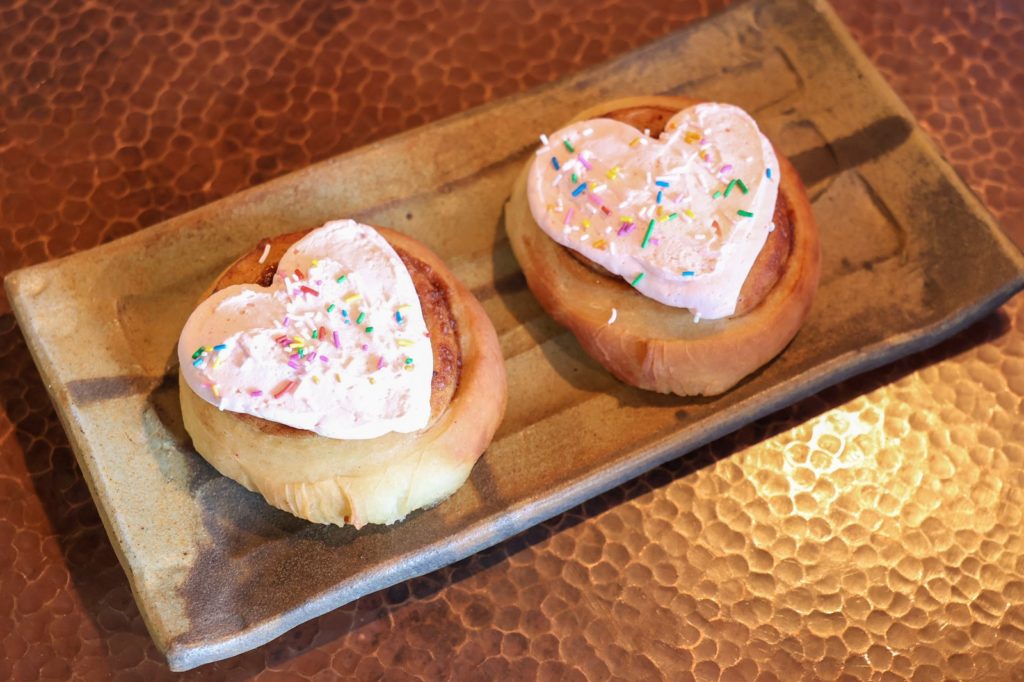
Elevate your drinks in honour of Valentine’s Day this February! Add coloured whipped cream to any hot or cold beverage with proceeds coming back to the Northern Cardiac Fund. Tie it all together with a delicious Persian Cinnamon Bun for $6, a tasty treat that makes a difference in our community – with $1 coming back to the Northern Cardiac Fund.
Stop by Copper Kettle Coffee House, enjoy a delicious drink and cinnamon bun and help make a difference for patients in our community.
This February, give your car (and your heart) a little extra love! Wakefield Oil Change Plus is teaming up with the Thunder Bay Regional Health Sciences Foundation for Heart Month! For every oil change in February, $1 will be donated to the Northern Cardiac Fund – helping support exceptional cardiac care right here in Northwestern Ontario.
Swing by 311 Cumberland St N during the month of February and help keep hearts (and engines) running strong!
Hosting the BIG GAME on Feb. 8 just got a whole lot easier!
Local catering company Gusterra is serving up ready-to-heat game day appetizer platters, with proceeds supporting life-saving cardiac care right here at home through our Northern Cardiac Fund.
To owners Theo Sundell and Beckham Thompson, Gusterra’s launch fundraiser is deeply personal. Cardiac care has touched their own family, and now they’re giving back! Platters come ready to serve 6-10 people, depending on how big your game day party will be! Platter for 6 is $110, platter for 10 is $160.
$25–$35 from every platter supports local cardiac care right here in Thunder Bay!
Pre-orders are open NOW until February 4, then you just pick up, heat, serve & enjoy. Pickup will be available at the RFDA at 570 Syndicate Ave S on February 7 and 8 from 12:00 p.m. – 4:00 p.m. at the kitchen entrance.
For more details and to order your game day platter, go to gusterra.ca/gameday
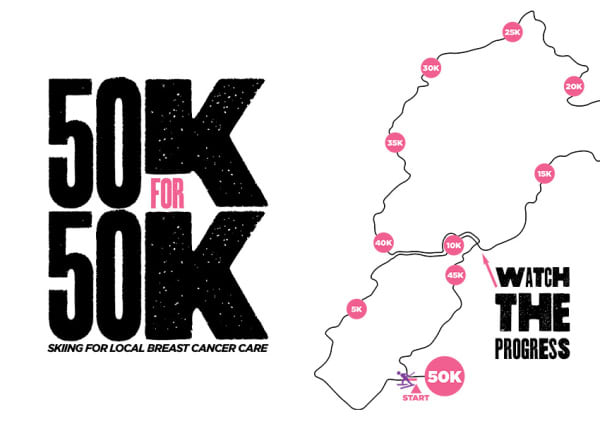
50K FOR 50K
Colin loves skiing, and for this year’s Sleeping Giant Loppet he has a lofty goal: Raise $50,000 for Exceptional local breast cancer care – that’s $1,000 for every kilometre he’s skiing!
With your help, we know he can do it!
You can support by donating – or if you’ll be in the Loppet you can fundraise, too!
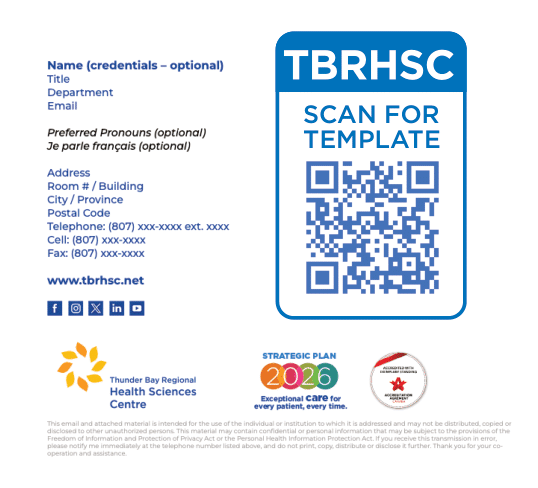
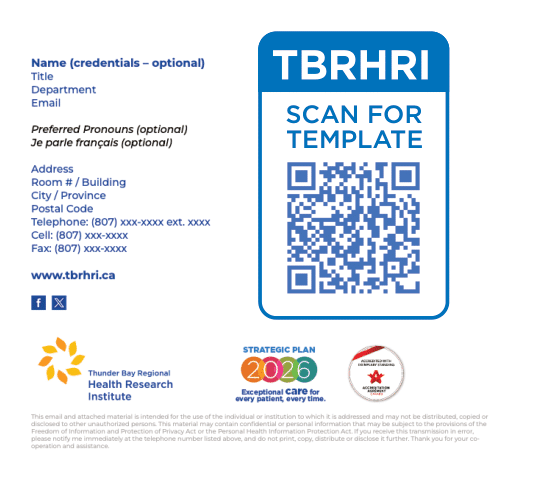
Now that all TBRHSC and TBRHRI employees are using Microsoft Outlook, this is a great opportunity to ensure your email signature aligns with our corporate branding standards.
Please apply the appropriate signature template (by copying and pasting) to all tbh.net email accounts and customize it with your individual information.
Using a standardized signature helps ensure our communications to other staff, partners in health, and the community are professional, consistent, and reflective of our shared organizational identity.
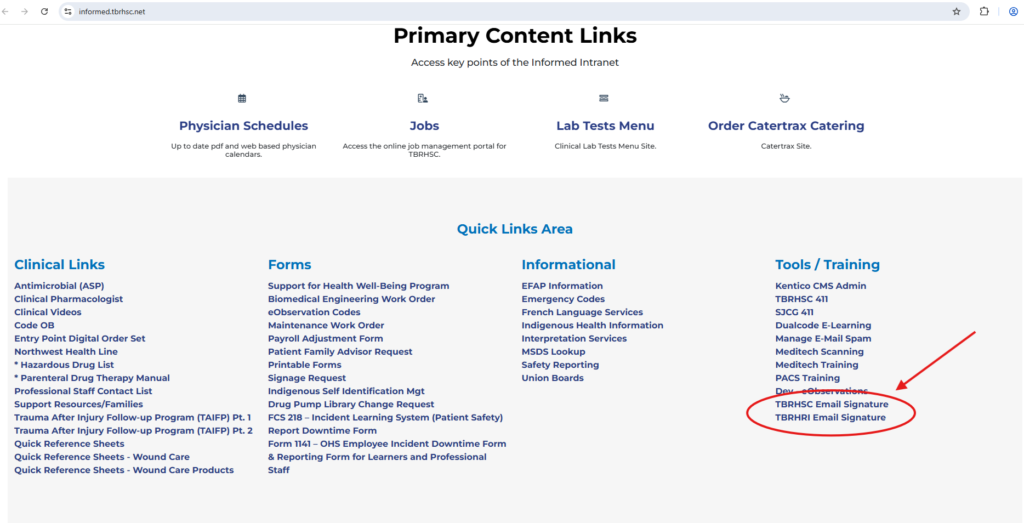
The approved signature templates are also available in the Quick Links area of the main page of the corporate intranet under Tools/Training.
At this time, the corporate email signature template does not support the inclusion of additional elements (e.g., other logos, advertisements for events or initiatives). For more information or questions, please contact the Communications and Engagement team.
Thank you for your cooperation and for helping maintain a polished and professional appearance in our email communications.
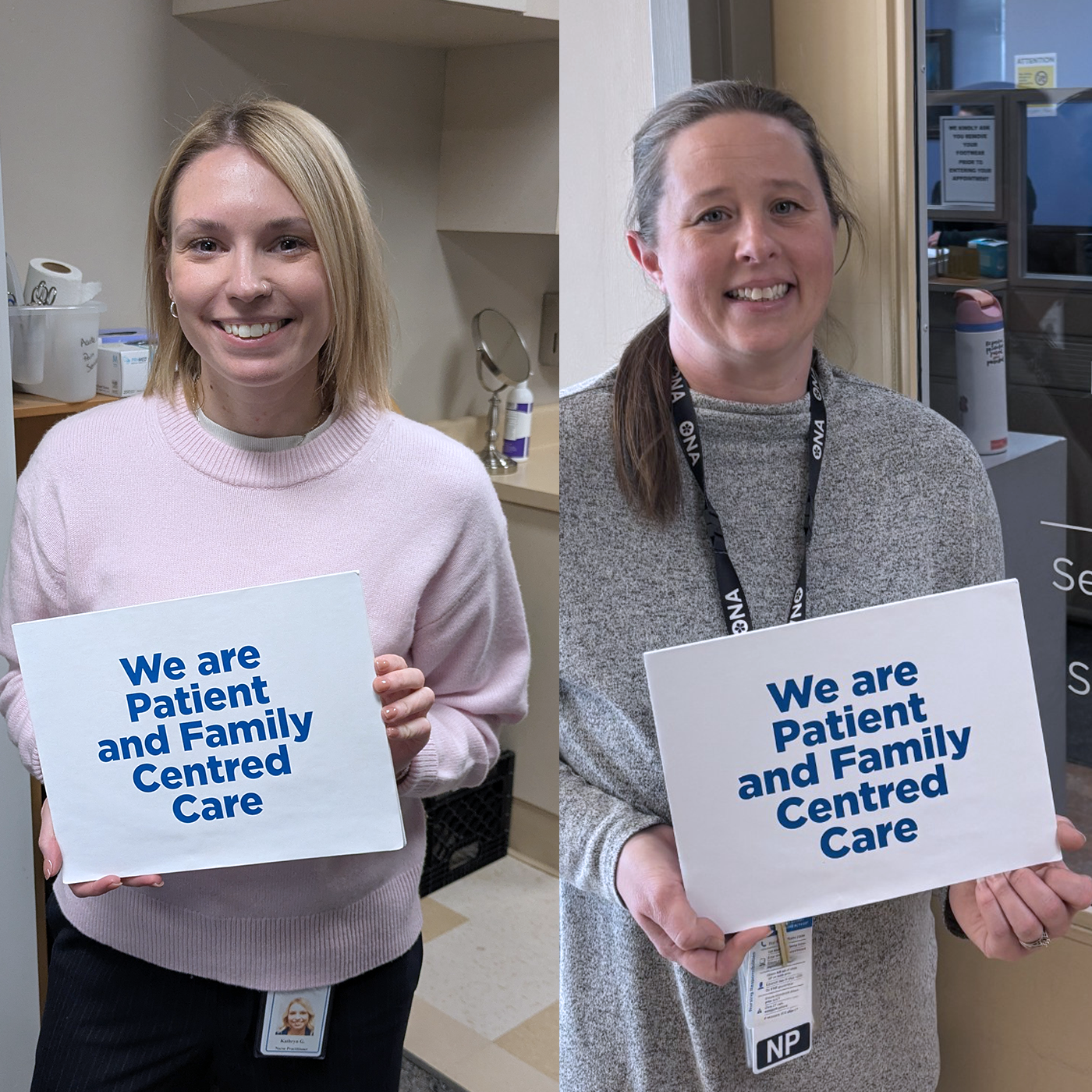
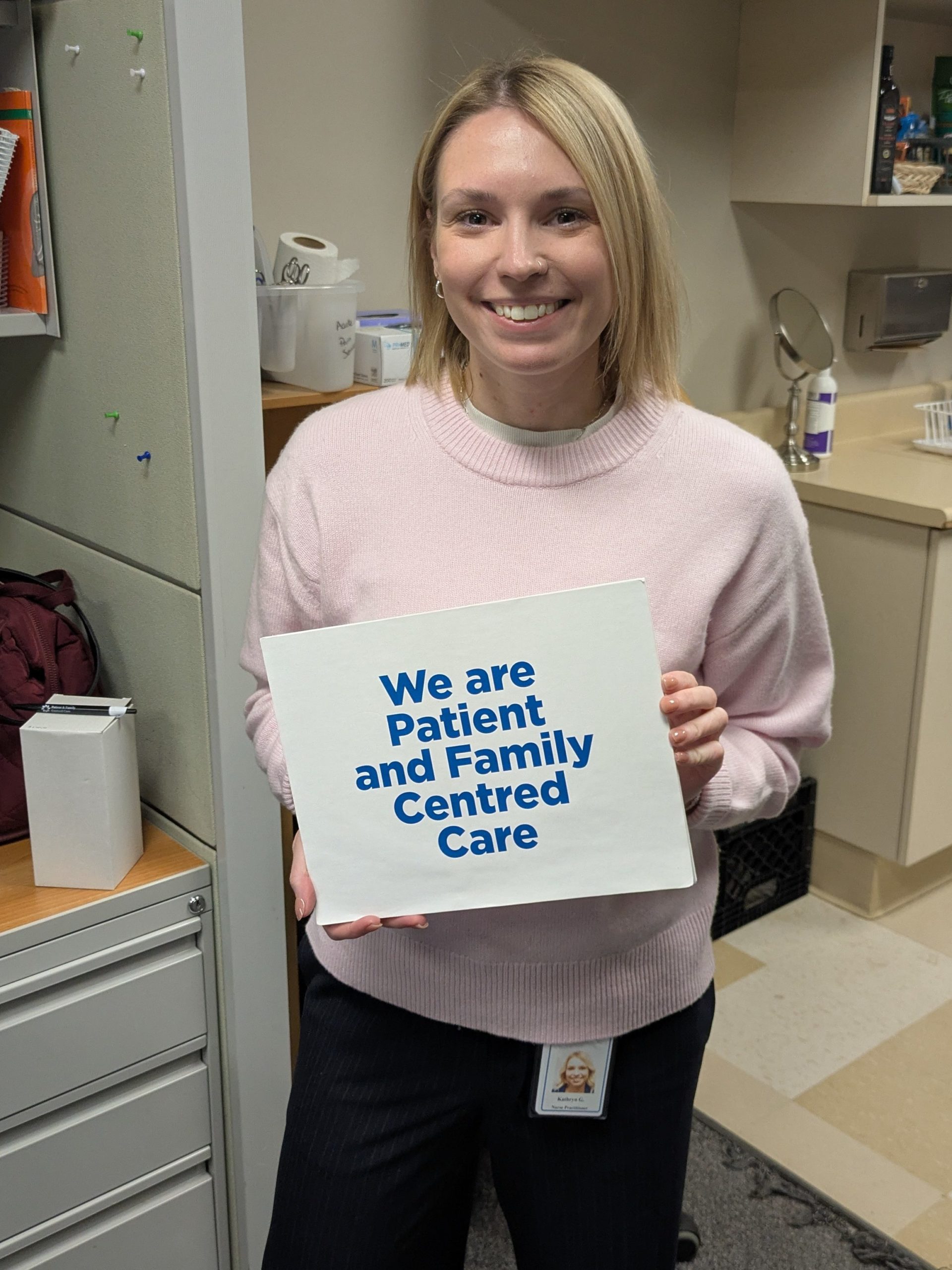
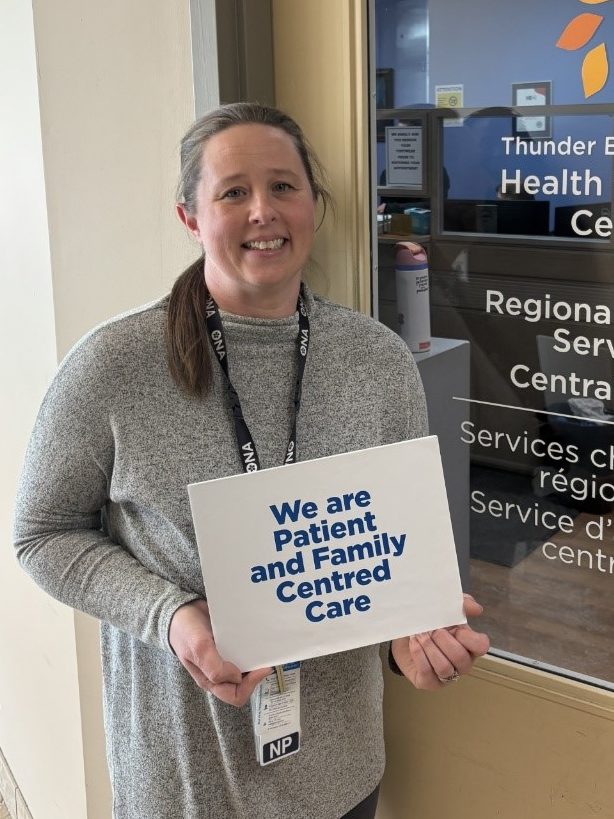
Congratulations to January’s Patient and Family Centered Care (PFCC) Shout Out Winners, Kathryn (Kat) Giba and Katie Cardy.
Both Kat and Katie embody PFCC within our organization by showing a commitment to communication, collaboration, dignity, and respect for their patients, enabling them to remain key participants in their own health.
Keep up the great work!
Kat Giba, Nurse Practitioner – Out Patient Antimicrobial Team
As a Nurse Practitioner with the new Out Patient Antimicrobial Team (OPAT), Kat has demonstrated compassion, empathy and collaboration by offering flexibility with appointment times that allow for her patients to navigate their care while juggling the complexities of their lives.
Kat Giba
Katie Cardy, Nurse Practitioner – Surgical Intake
Katie Cardy is a Nurse Practitioner with the Surgical Intake department whose colleagues have witnessed as always going above and beyond for her patients, always taking the extra time to listen to the patients, and truly caring about having positive outcomes for every patient she sees!
Katie Cardy
Do you know someone in our organization who consistently demonstrates exceptional Patient and Family Centred Care (PFCC)? We want to hear about them!
Simply send a PFCC Shout Out email to TBRHSC.PFCC@tbh.net and include the staff member’s name, department, and a brief description of what they did that deserves recognition.
Let’s celebrate the people who make this a truly patient and family centred organization.
Clean hands are one of the most effective ways to prevent the spread of infection. Infection Prevention and Control (IPAC) reminds all staff to follow proper hand hygiene practices as outlined IPC-2-12 Effective Hand Hygiene.
From February 2 until February 13, members of the IPAC team will be visiting departments to observe and support hand hygiene practices. Staff demonstrating proper hand hygiene may receive draw tickets, with prizes drawn weekly.
Please remember to wash or sanitize your hands:
Before patient contact
Before a clean or aseptic procedure
After body fluid exposure risk
After patient contact and contact with the patient environment
Help Us Celebrate Staff Who Go Above and Beyond for Patients and Families
Do you know someone in our organization who consistently demonstrates exceptional Patient and Family Centred Care (PFCC)? Someone who takes the time to truly listen, who includes patients and families in care decisions, and who ensures everyone feels respected, safe, and valued?
We want to hear about them!
Each month, the PFCC team is accepting “PFCC Shout Outs”—recognizing staff across all departments who go the extra mile to make the patient and family experience better. Whether it’s a small gesture of kindness, a meaningful conversation, or an example of true collaboration and compassion, we want to celebrate those moments.
What does a PFCC Shout Out look like?
A nurse who takes time to explain care options in a way the patient understands
A porter who makes a patient feel comfortable and less anxious during a transfer
A unit clerk who warmly greets families and helps them navigate the hospital
A physician who ensures the family is included in rounds and decisions
Any team member who prioritizes dignity, respect, and collaboration
How to nominate someone:
Anyone—staff, patients, families, or volunteers—can nominate a staff member by sending a quick email to TBRHSC.PFCC@tbh.net.Just include the staff member’s name, department, and a brief description of what they did that deserves recognition.
Monthly winners will receive a small prize, have their photo featured on the PFCC intranet page, and be highlighted in The Informed newsletter.
Let’s celebrate the people who make this a truly patient and family-centred organization. Start shouting out today!