
Dear Staff, Professional Staff, Learners, Volunteers, Researchers, and Board members
Greetings, Boozhoo and Bonjour,
I would like to begin this month’s blog by acknowledging the information we have learned as Canadians regarding the discovery of 215 children in a mass grave at the site of a former residential school in British Columbia.
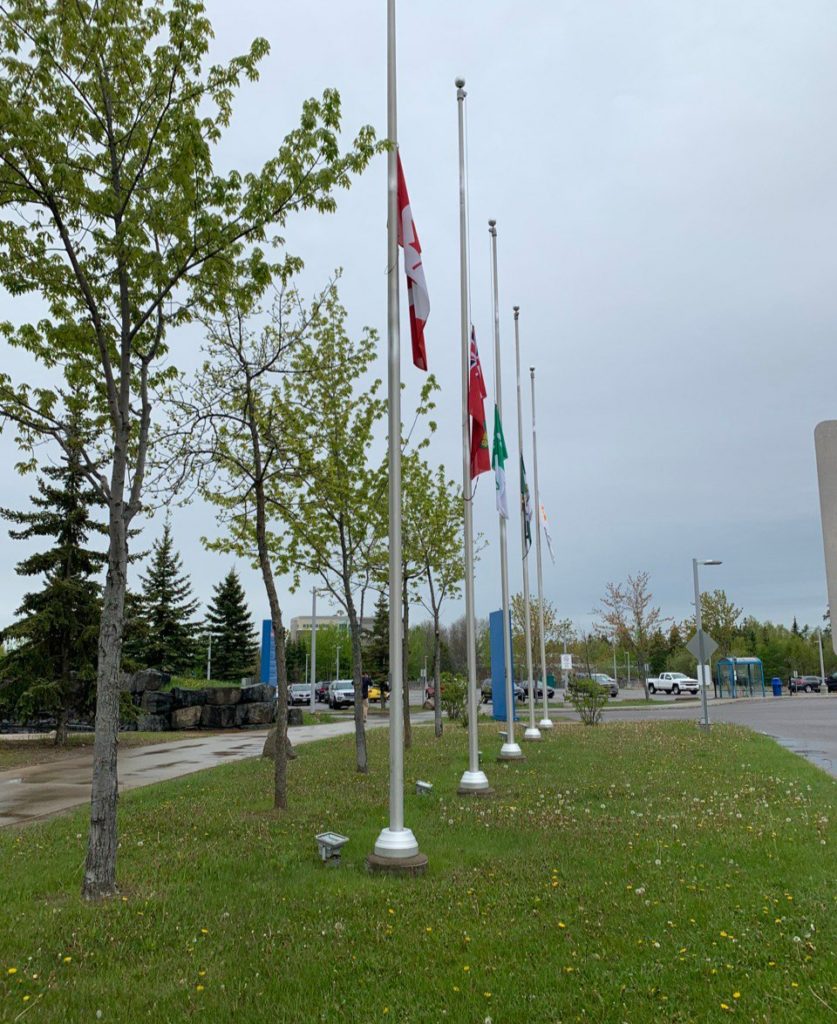
Flags at Thunder Bay Regional Health sciences Centre (TBRHSC) will be flown at half-mast from May 31 to June 8 to honour them. The flags will remain lowered one hour for each child whose life was taken, and in memory of the thousands who are survivors of residential schools, for those who never returned, and in honour of the families whose lives were forever changed.
I know there are many people in our city and region who have been personally impacted by the residential school era, and that this horrific latest news may cause you a great deal of mental health challenges. I encourage you strongly to utilize our internal resources that are there for all staff. For former students and others impacted, a National Indian Residential School Crisis Line is available 24 hours a day at 1-866-925-4419.
Reconciliation with the Indigenous community is a priority for our Hospital. In line with the Truth and Reconciliation direction, “…reconciliation requires that a new vision, based on a commitment to mutual respect, be developed. It also requires an understanding that the most harmful impacts of residential schools have been the loss of pride and self-respect of Aboriginal people, and the lack of respect that non-Aboriginal people have been raised to have for their Aboriginal neighbours. Reconciliation is not an Aboriginal problem; it is a Canadian one”. Our Hospital is working to make changes that are aligned with the Truth and Reconciliation recommendations. We will work to create a safe and responsive environment for all Indigenous people.
COVID-19
As the Covid-19 pandemic has evolved into a more manageable stable state, we have been assessing opportunities to consider our future operations going forward. We recognize the need to be nimble and rapidly respond to a potential escalation and changing needs, while managing the organizational operations into a steady state. To facilitate a successful transition for Covid-19 management going forward, we have worked together with IMT (Incident Management Team) to engage in options for a transition plan. Given that Covid-19 will likely remain a part of our daily lives for some time to come, and recognizing our current state, the choice was made to shift IMT leadership to Senior Leadership. This transition places operational management of our Covid-19 response in our patient care portfolio under the leadership of Dr. Peter Voros, while enabling the continued support for the response from the organization through the Senior Leadership Team.
To support the transition, we have initiated daily operational situation updates to replace IMT updates. This transition is intended to ensure the full engagement of the organization in the careful planning, communication, and responsiveness to changing needs with Covid-19, while recognizing the shift to senior leadership for decision making. We will assess the shift in structure and continually look for your input into decisions through the regular dyad operational model.
As we shift gears, I would like to recognize the incredible work done through IMT and call out a recent notable change. Given the feedback and stories received from a number of our patients, families, and staff, the team engaged at many levels to assess the Essential Care Partner policy and process. Through discussion with Ethics, Infection Prevention and Control, and so many others, the recommendation was made to support the inclusion of one Essential Care Partner for each patient in hospital. The journey has been challenging, yet the outcome will dramatically change the experience of care for so many going forward. It is decisions like these that have a profound and life altering impact upon so many individuals. Thank you again to the team for listening to the stories, assessing the risks and benefits, and supporting a changing environment that leads to positive feedback.
I would also like to take the opportunity to thank all of you who participated and contributed over the past 15 months for your strong commitment, expertise, and leadership. While we continue to manage Covid in our community and organization, we hope that we have reached a more manageable steady state that enables transition forward.
Strategic Planning
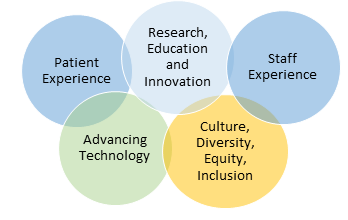
Our Strategic Plan 2026 is well under way with stakeholder engagement providing some very good inputs and perspectives. While we continue to refine and identify key areas of focus, we have seen some significant themes emerging. High-level areas for further development include the following:
On behalf of the Hospital and the Research Institute, I would like to thank everyone for their participation and input. Your voice helps us to ensure we create a roadmap that will have a profound impact on health outcomes in our community and our region. We hope that by the end of June 2021, we will have landed on our high-level themes for action planning and indicator development over the summer period.
Organizational Structure Changes
As we challenge ourselves to evolve as an organization and focus on our strategic priorities going forward, we are engaging in a process to ensure we are aligned to best affect the needed strategy and changes at the senior level. As a first phase of this, I have posted the EVP Patient Experience role to replace the operational leadership vacancy left through the restructured EVP medical role. In this phase, we will recruit an EVP Patient Experience to work in collaborative partnership with EVP Inpatient Programs to lead all patient programs and services operationally. This shift is done with cost savings and a longer term view to the potential integration of nursing leadership into this modelling. Once this critical staff recruitment is complete, the senior leadership team will work to engage in a more fulsome operational model that will seek to enhance quality while streamlining leadership that models the patient journey and supports the overall strategic priorities of the organization.
Final Thoughts
June is Pride Month, and TBRHSC is showing its support by raising the Progress Pride flag in recognition and demonstration of our commitment to a kind, accepting, and inclusive culture for all.
In terms of the pandemic, while we are certainly not without challenges, we are moving closer to a steady state as a Health Sciences Centre and Research Institute. Previously the epicentre of the pandemic in Ontario, we are now doing our part to serve other regions who were once in our situation. With cases down and vaccination rates improving, we are able to slowly increase surgeries and procedures and return to something closer to normal. We are vigilant and cautious, but optimistic that we may be approaching our new normal hospital environment for some time to come.
The timing couldn’t be better as we start to ramp up outreach and planning involved with developing our Strategic Plan 2026 – a crucial document for the ‘recovery’ period. I must commend everyone involved with moving this forward the past few months during some of the worst parts of the pandemic regionally. I know this wasn’t easy and want to thank everyone for their attention.
In closing, my heartfelt thanks to you all for stepping up when we needed you most – supporting the organization and our many asks, working outside your comfort zone – all in the name of patient care, and in support of one another. Together, your efforts have supported our movement toward recovery while ‘flattening the curve’ in our area and beyond. Your outstanding efforts have made THE DIFFERENCE! On behalf of the entire organization, we recognize and greatly appreciate everything you do to support us all in these unprecedented times.
Please continue to stay safe and be well.
As summer approaches, I do hope each and every one of you can enjoy some time to refresh and rejuvenate. It’s been a tough year, and I am hopeful that you are able to enjoy the things that make you smile.
I welcome comments on this blog or any other matter. You can reach me at: crockerelr@tbh.net.