In the News: Hospital launches workplace violence campaign, reporting rising numbers

(via tbnewswatch.com)

Thunder Bay’s regional hospital is launching a campaign to tackle workplace violence, pointing to a dramatic increase in incidents of verbal abuse and physical assault against health care workers.

The initiative is launching with an awareness campaign designed with input from staff and patient advisors, but will expand to include more concrete actions, pledged hospital CEO Rhonda Crocker Ellacott.

The Thunder Bay Regional Health Sciences Centre has struck a working group on workplace violence that will explore other actions including increased security measures and changes to communication practices.

The campaign was prompted by a noticeable rise in violence during the COVID-19 pandemic, particularly in the Emergency Department, Crocker Ellacott said.

“During the pandemic, for whatever reason, it’s become more acceptable – and it’s really not,” she said. “We’re working our very best to provide you with exceptional care. Work hand in glove with us, please.”

It’s part of a trend of escalating workplace violence faced by health care workers, with local paramedics also exploring ways to address a problem leaders said has reached a “boiling point.”

“We’ve seen violence towards our health care workers up 50 per cent between 2019 and 2021,” reported Crocker Ellacott. “In fact, 50 per cent of our nurses report experiencing some type of violence on a daily basis.”

“We need to make sure this does not continue.”

Incidents of violence in the Emergency Department have risen from 138 in 2019 to 213 in 2021, with more than half of that total involving physical violence.

In 2021, that included 65 instances of physical contact, 31 incidents of attempted physical contact, 78 incidents of verbal abuse or harassment, and 39 involving both physical contact and verbal harassment.

There has been some lost time related to violent incidents, and Crocker Ellacott said that figure has also escalated.

A 2017 report by the Canadian Federation of Nurses Unions (CNFU) found violence-related lost time claims increased by almost 66 per cent in the preceding decade – three times the rate for police and correctional service officers.

The trend has led the hospital to expand some of its safety and security practices in the Emergency Department, including introducing metal detector wands several years ago. Those are used every day, she said.

“We have already expanded some of our safety and security functions in the Emergency Department, but we continually look at what is best practice and how to do that more effectively, whether it’s security guards, police, a combination thereof, social workers – there’s various strategies that we put into effect in order to provide best care for patients and safety for staff.”

The incidents of violence involve less than one per cent of those who access the hospital, but it’s still adding up to “far too much” for health care workers, she said.

“We recognize that [when people] access the Emergency Department or any part of the health sciences centre, it can be an incredibly stressful and emotional experience. But at the same time, we really need the respectful and courteous communication and interactions from patients.”

The hospital’s awareness campaign is launching with posters in the Emergency Department, the primary location where workplace violence occurs, and is expected to expand from there.

A former nurse, Crocker Ellacott said health care workers have always faced violence, but the risks grown to an unacceptable level.

“I’ve seen it and I’ve experienced it myself, from the perspective of being a frontline nurse early in my career, but not like we see it today,” she said. “It’s escalated significantly. It’s really time to make a change and call attention to it, make it a priority, and make it stop.”


Looking for Healthy Models

EM CPoCUS Course

July 6-7-8, 2022
8:00 am – 6:30 pm
NOSM University

By participating, you will allow Emergency Medicine residents training in your community to learn to use ultrasound to look for potentially life threatening conditions.

As a model, you will help training physicians to distinguish between what a normal person looks like on the inside, and something abnormal they need to recognize quickly to save lives. You will also see some medical training in action.

While you are with us, the trainee will put an ultrasound probe on your abdomen or possibly upper chest just below the collarbone. They will press or move probe around. THIS WILL NOT HURT AND IT IS NOT DANGEROUS. It can get a little slimy since gel is used to ensure sound transmission through the skin.

Females must be comfortable wearing a sports bra or tank top, and male models need to be shirtless. You will be asked to provide your age, gender and BMI to ensure medical trainees learn to scan on models representative of population. The course will take place at NOSM University (Medical School building) Lakehead University campus, 1st floor.

You would be requested to participate in blocks of about 1.5 to 2.5 hours. Participants will be compensated for their time. High school students may be compensated for their time OR be assigned volunteer hours.

Scan the QR code to sign up:

For more information, please contact:

Erica Dzuba
Standardized Patient Program Coordinator
NOSM University, MS-1009, 955 Oliver Road
Thunder Bay, ON, P7B 5E1
Tel: 807-766-7335, Cell: 807-629-0065
Email: edzuba@nosm.ca

Course Director

Dr. Patrick Martel, MD CCFP(EM) FCFP
Director, ED PoCUS Program, TBRHSC

Join the Active Commute Challenge

Do you actively commute to work? Do you like to win prizes?

If you answered yes to one of these questions, it is not too late to enter the TBay on the Move Active Commute Challenge.

Throughout the month of June, rethink your commute and swap your car with any form of active transportation. Whether you are working at home or on-site, you can still participate in the Challenge by walking, cycling, running, rollerblading, using public transit, or even paddling to and from work or on your own time.

To date, Thunder Bay Regional Health Sciences Centre’s team has saved 106.25 kg of greenhouse gas emissions and actively commuted 518.89 km.

If you have been actively commuting throughout the month of June, it is not too late to sign up and be entered to win some great prizes. Sign up for our Hospital’s team at www.TbayOnTheMove.ca

Below are the steps you need to take to join.

Step 1: Sign up.

Click the sign up button in the top right corner of the website and start by creating your profile.

Step 2: Find your team.

After you sign up, you will search your workplace, ‘Thunder Bay Regional Health Sciences Centre’ (start typing Thunder Bay Regional Health Sciences Centre and it should appear in the list as an option). Select ‘Thunder Bay Regional Health Sciences Centre’ to join the team.

Step 3: Track your progress.

You can track your distance commuted at any time in your profile. Just select the date and enter the distance travelled and your progress will be tracked.

Coming Soon – ROMEO Research Portal

In line with the directions of Strategic Plan 2026 for Research Innovation & Learning, Thunder Bay Regional Health Sciences Centre (TBRHSC) and Thunder Bay Regional Health Research Institute (TBRHRI) are pleased to announce that we are transitioning to an electronic research administration and application system called ROMEO Research Portal during Summer 2022.

What is ROMEO Research Portal?

The ROMEO Research Portal is an online digital platform used by dozens of academic and healthcare institutions across Canada for managing their clinical research needs in terms of reviews, approvals, tracking, and reporting.

Why are we making this change:

The system will streamline the ethics and institutional authorization process for research in a number of ways, including:

  • Reduced administrative data entry by collecting data via online workflow processes
  • Tracked deliverables and auto-prompt reminders for re-approvals
  • Tracked and automated approval processes, reducing the time to obtain signatures

When will the ROMEO Research Portal be live?

We plan to go live with the platform in early August, 2022. Prior to that date, guidance documents and training will be made available to users.

What does this mean for Researchers?

While the application itself will feel similar, researchers will now be able to complete a single, combined application for both ethics and institutional approvals. Our goal is to reduce overall review times and continue to enhance the quality and clarity of our applications and forms. Configurable controls will prevent incomplete submissions and improve submission quality.

What does this mean for TBRHSC Staff who review research for departmental impact?

If you are a Manager or Director at TBRHSC who reviews research for local impact or endorsement, this will now take place within the Research Portal. An account will be generated for you, and you will be notified when there is an application involving your program or department that requires your review. By logging into the Research Portal, you will be able to review your program or department’s involvement and confirm support, or request additional details, if needed.


For more information, please contact Daniel Horne, Manager of Clinical Research Services at Daniel.Horne@tbh.net, or Statton Eade, Research Ethics & Authorization Coordinator at Statton.Eade@tbh.net.

Employee Donor Spotlight: Karen, Oncology

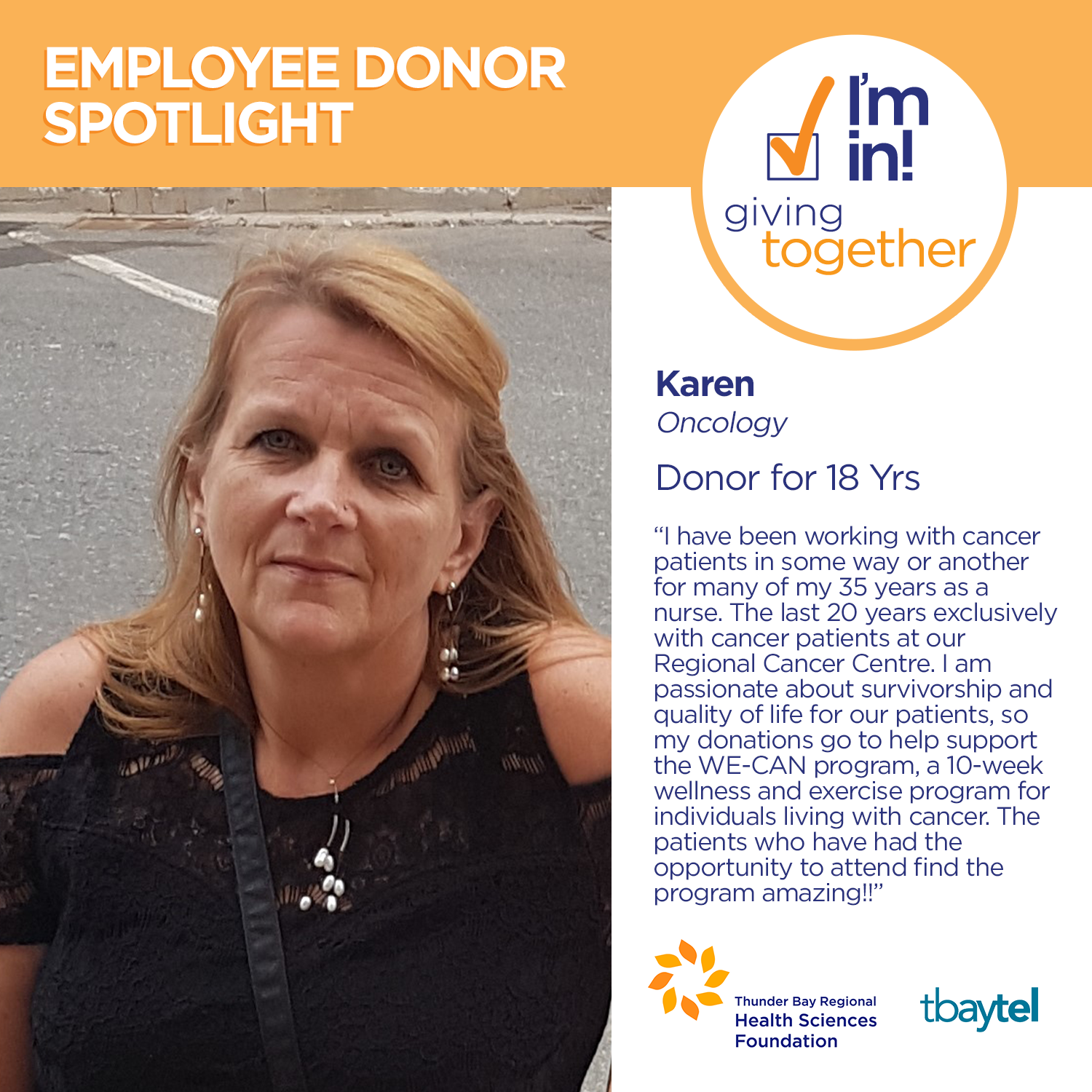
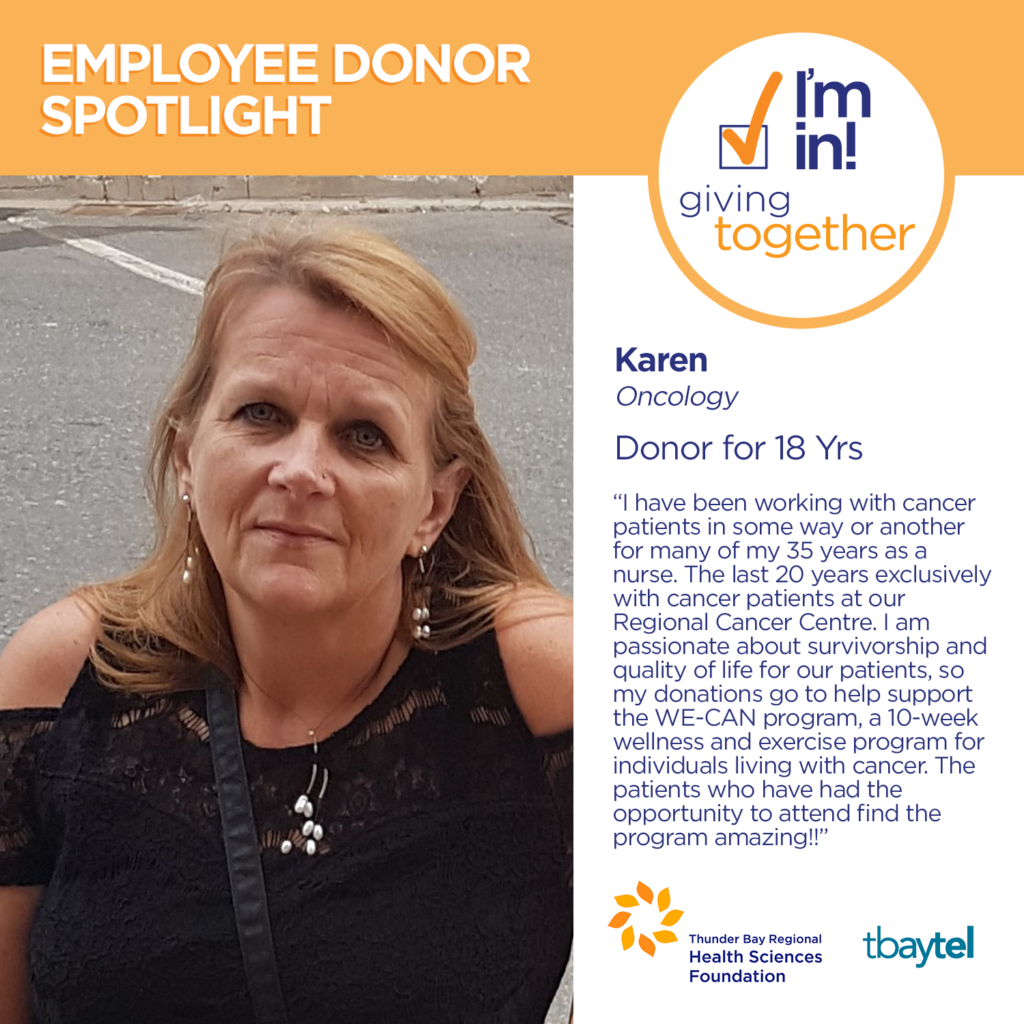
Today’s Employee Donor Spotlight features Karen from the Hospital’s Oncology department. Karen has been an Employee Donor for 18 years!

“I have been working with cancer patients in some way or another for many of my 35 years as a nurse. The last 20 years exclusively with cancer patients at our Regional Cancer Centre.” says Karen, “I am passionate about survivorship and quality of life for our patients, so my donations go to help support the WE-CAN program, a 10-week wellness and exercise program for individuals living with cancer. The patients who have had the opportunity to attend find the program amazing!!”

Thank you, Karen!

Employee Donors are Thunder Bay Regional Health Sciences Centre staff who donate through payroll deductions, helping to fund Hospital equipment in the area that means the most to them. Their dedication to better local healthcare is shown in both the hard work they do and their donations. Thank you to Tbaytel, who matches annual Employee Donor contributions up to $7,500!

If you’re a Hospital employee you can sign up, too! Learn more at www.healthsciencesfoundation.ca/imin

COVID-19 Outbreak: 2B Unit

Shared on behalf of Infection Prevention and Control


A COVID-19 outbreak has been declared on the 2B Unit as of June 13, 2022. All restrictions are in place.

As always, our number one priority is the safety of patients and their families, staff and visitors. All patients identified as having an exposure to this outbreak have been isolated with appropriate additional precautions. Essential Care Partners will only be permitted on a case-by-case basis, following the process outlined in the Care Partner/ Essential Care Partner Guidance Document.

Infection Prevention and Control encourages everyone to continue applying routine practices of hand hygiene, proper use of PPE, cleaning shared equipment and the appropriate screening of all patients. Please set an example to staff and students and assist us by maintaining compliance and due diligence. Staff with questions regarding potential exposures should contact Occupational Health and Safety.

Notice will be sent when the outbreak is declared over.

For more information, please contact Infection Prevention and Control at extension 6094.

Hospital Campaign Brings Awareness to Workplace Violence

Thunder Bay Regional Health Sciences Centre (TBRHSC) has launched a public campaign aimed at bringing awareness to the issue of workplace violence.

Designed internally, and with extensive input from front line staff and Patient Family Advisors, the campaign will acknowledge the workplace violence challenges in the ED, remind the community to act in a respectful manner with health care workers, emphasize that any form of violence will not be tolerated, and show support for ED staff and all health care workers at TBRHSC.

Over the past decade, workplace violence in the health care sector has been increasing, and the COVID-19 pandemic has only magnified the issue. A 2017 report by the Canadian Federation of Nurses Unions (CNFU) states “the number of violence-related lost-time claims for frontline health care workers has increased by almost 66% over the past decade, three times the rate of increase for police and correctional service officers combined.”

“Health care workers have the right to do their jobs in an environment that is free from violence,” said President and CEO, Dr. Rhonda Crocker Ellacott. “Workplace violence can take the form of physical assault, emotional or verbal abuse, racial or sexual harassment, or bullying and can be perpetrated by patients, family members and other visitors, co-workers or superiors. Workplace violence affects both staff and patients while eroding the quality of care and impacting health outcomes.”

The TBRHSC Emergency Department Workplace Violence Prevention Working Group is actively planning, implementing and evaluating strategies for preventing violence, with the goal of making the Emergency Department safe for staff, and in turn, patients and their families. The strategies will be utilized across the organization to further enhance workplace safety and protect everyone who visits our Hospital. 

To learn more, follow TBRHSC on social media and visit www.tbrhsc.net.


Manager, Cardiac Catheterization Lab, Pacemaker Clinic & Visiting Clinics

Shared on behalf of Wayne Taylor, Interim Director, Cardiovascular Sciences Program and Ron Turner, Director Medicine and Renal Services


We are pleased to announce the appointment of Martin Sabourin to the position of Manager, Cardiac Catheterization Lab, Pacemaker Clinic & Visiting Clinics.

Martin holds a Bachelor of Science in Nursing (BScN) and began his career as a Registered Nurse in the Emergency Department (ED) at the Thunder Bay Regional Health Sciences Centre (TBRHSC). As a member of the Critical Care Resource Team, Martin also gained valuable experience working as an RN in our Intensive Care Unit (ICU) and Post Anesthetic Recovery Unit (PACU) before advancing to the role of Clinical Nurse Specialist (CNS) for the ED.

Since 2018, Martin has been a Nursing Practice Leader in the department of Professional Practice at TBRHSC where he has been actively involved in initiatives and ongoing efforts to develop and improve safe practice and the delivery of quality patient care across the organization.

Additionally, Martin is a member of the College of Nurses of Ontario (CNO) Council as an RN representative for the Northwest Region and participates in the disciplinary and fitness to practice committees as part of the CNO’s regulatory oversight of nursing practice.

Martin will begin his new role on June 20, 2022, and will oversee the operations of the Cardiac Cath Lab, Pacemaker Clinic and Visiting Clinics with direct report to Ron Turner, Director Medicine, Renal and Cardiovascular Services.

Please join us in welcoming Martin to his new role.

>