Shared on behalf of Infection Prevention and Control
A COVID-19 outbreak has been declared on the 2B inpatient unit as of March 25, 2024. All restrictions are in place.
Please share this information with the appropriate staff.
As always, our number one priority is the safety of patients and their families, staff and visitors. All patients identified as having an exposure to this outbreak will require isolation with appropriate additional precautions.
The Infection Prevention and Control department encourages everyone to keep applying the routine practices of hand hygiene, proper use of PPE, equipment cleaning, and the appropriate admission screening of all patients. Please set an example for staff and students and assist us by maintaining compliance and due diligence.
For more information, contact Infection Prevention and Control at Ext. 6094.
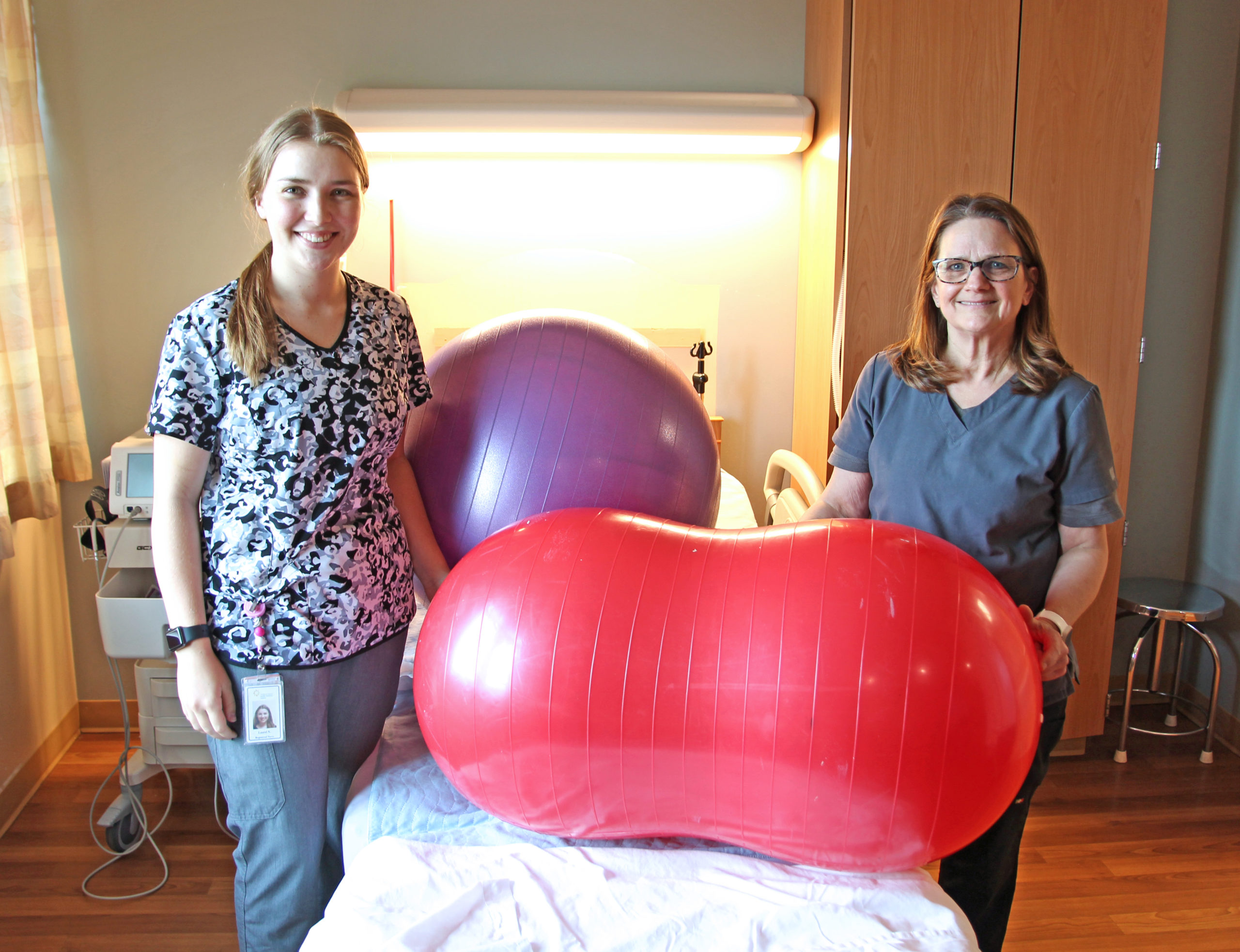
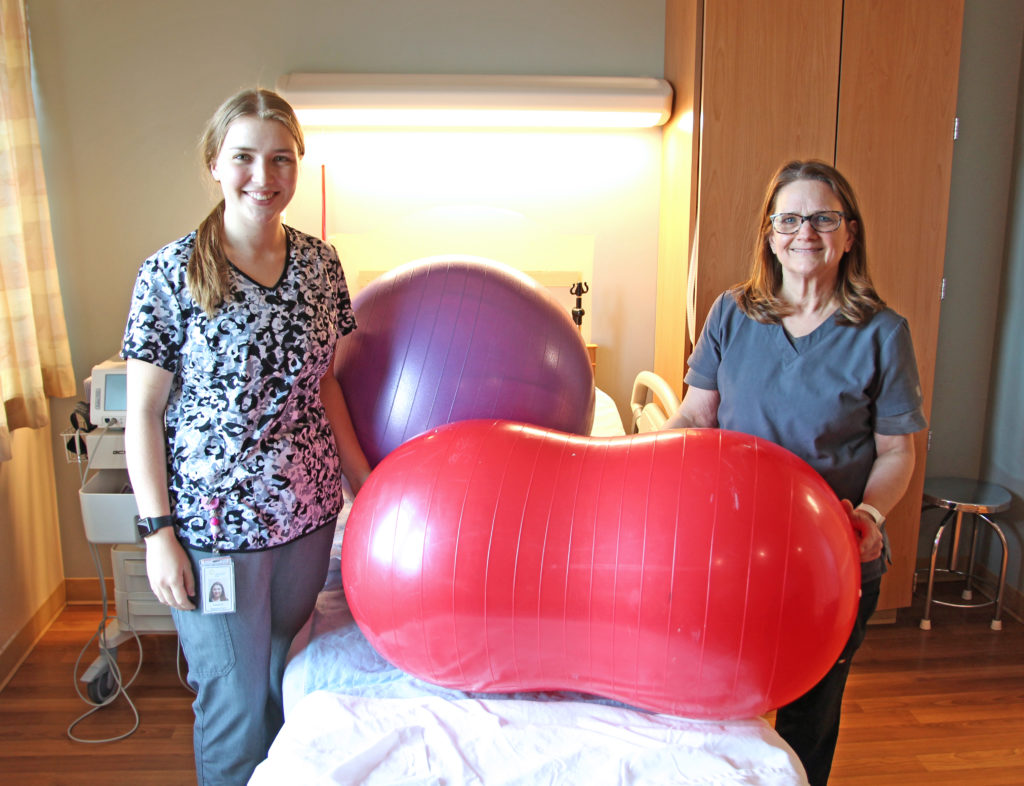
(L-R) Laurie Norris, Composite RN (MNB and L&D) and Candyce McKinnon, RPN (MNB) pose with the “peanut” ball, a tool used to mimic a squatting position for labouring individuals who have opted for an epidural.
There is no one position that is better than another during labour. It’s important to try different positions to help cope with pain and help labour along. Standing, walking, or swaying can help in early labour. Lunging, kneeling, and squatting are also helpful positions to work with your body as the baby descends in the pelvis.
We offer different forms of pain management during labour. Labouring individuals can choose between warm water immersion, birthing balls, entonox gas, sterile water injections, IV pain management, and epidurals.
Often, having an epidural can limit a person’s movement. At TBRHSC, we offer the use of “peanut” balls to mimic a squatting position for those who have opted for an epidural. This position effectively facilitates fetal rotation and descent during vaginal birth and allows a person the option of having an epidural but still being able to try different positions during labour.
No referrals are necessary to access care at the Maternity Centre.
The Ladies of The Italian Society of Port Arthur are hosting their annual Spring Tea in support of The Northern Cancer Fund on Sunday, April 21.
Dress to impress and join us at the Italian Cultural Centre at 132 South Algoma Street for an Afternoon Tea featuring a bake sale, door prize, and a penny auction!
Tickets are available for purchase at the Health Sciences Foundation donation office inside the Hospital beside Robin’s Donuts, or available at the door on event day.
Join members of the Confederation College Performing Arts Club along with guests from Applauze Productions, Cambrian Players, and World Cultural Dance in a show full of laughs, songs, dance, and more!
A little something for everyone with proceeds to support the Northern Cancer Fund.
Tickets are $10 each with 2:00 p.m. and 7:30 p.m. shows on Saturday, April 6 at the College’s Dibaajimogamig Theatre.
It’s your last chance to get your J&J Sports Save a Heart Raffle tickets in support of the Northern Cardiac Fund. Our volunteers will be in the main lobby of the Hospital during the following days and time:
Monday, March 25, 11:00 a.m. to 2:00 p.m. Thursday, March 28, 11:00 a.m. to 2:00 p.m.
Tickets are $20 for one, three for $50, or 10 for $100 with cash or square options available.
Tickets are also available at Balmoral Park Acura, Superior Strategies, J&J Sports, the Thunder Bay 50/50 store at Intercity Shopping Centre on Thursday, or in our Donation Centre beside Robins.
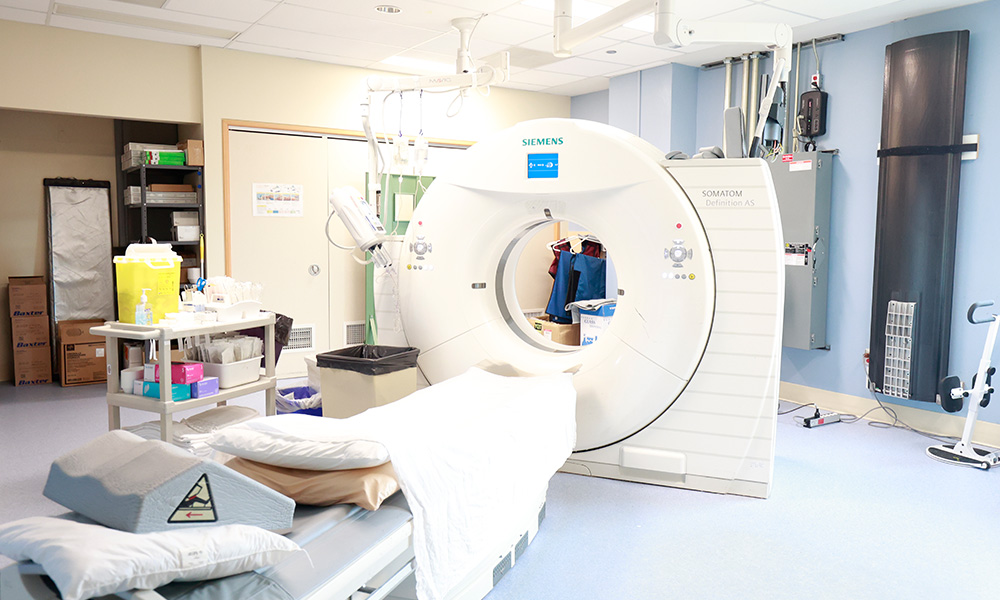
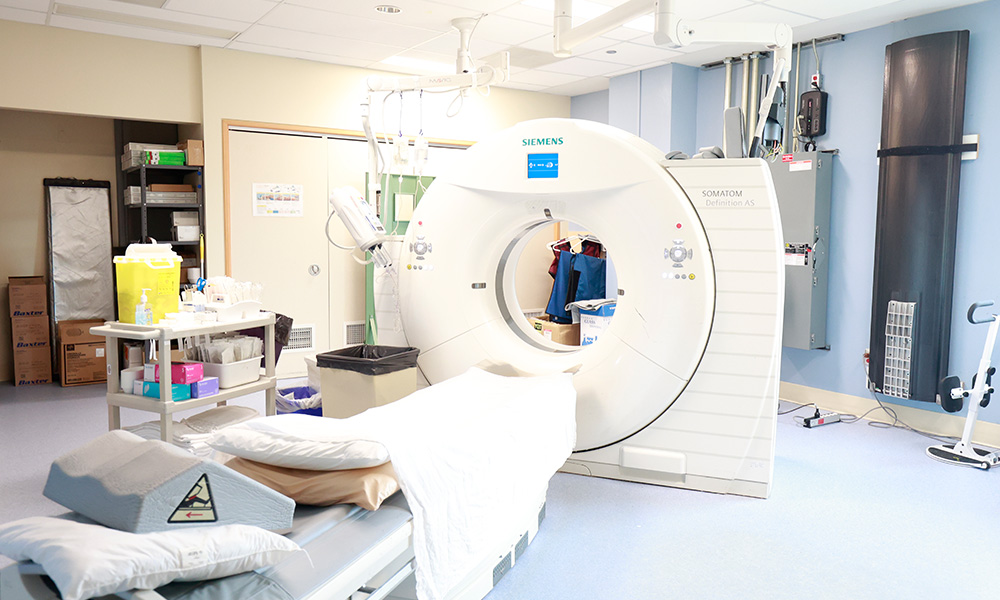
Thanks to Thunder Bay 50/50 supporters and Foundation donors, this 13 year old CT Scanner is being replaced at the Health Sciences Centre. The new unit will feature technology advancements which include enhanced images using lower doses of radiation, making scans faster and safer for patients. Last year, over 35,000 CT scans were done at the Hospital.
CT scanners, like all medical devices, can’t keep running forever. High-precision, high-workload components wear out over time and technology keeps getting better. The Siemens CT scanner our Hospital installed in 2011 is quickly becoming worn down and obsolete.
But thanks to your support of the Thunder Bay 50/50 draw, a new CT scanner will soon be on its way.
“There are advancements in technology every year,” Craig Willson said. Most of that is in the area of software, which can enhance images using lower and lower doses of radiation. This makes scans faster and safer for patients. “The ultimate goal is to get the lowest dose of X-rays with the best image possible.”
Breakdowns are becoming more common with this older unit, which lead to delays in patient care. The CT scanner runs 24 hours, five days per week and 16 hours per day on the weekends. That makes it difficult to catch up again after a delay.
“The CT goes down on average once per month now. Obviously, the faster we can replace it, the better,” Willson said. The hope is to have a new one selected and installed by summer.
CT wait times have become an issue across Canada. Emergency and urgent CT scan wait times remain low at our Hospital. But wait times for non-urgent scans have become even more of an issue across Canada since COVID. Our wait times remain on the lower end compared to other hospitals in the province, but they are not where our Hospital wants them to be.
The best way to help Hospital staff reduce those wait times is to ensure the CT scanner is up and running as much as possible. Replacing it now will greatly reduce delays caused by breakdowns.
“Our service engineer told us we have at least 15 years’ worth of use out of the scanner in the 13 years we’ve had it,” Willson said. “That’s due completely to the amount of use it gets.”
In fact, CT use in general has grown over the years, in part due to its growing versatility. Our Hospital has two standalone CTs for patient scans. The one being replaced now is the “workhorse” unit that gets the most use: inpatient, outpatient, emergency cases, regional patients, and special procedures including kidney cancer biopsy/treatment and lung biopsy.
“This CT does the majority of CT-guided special procedures in Northwestern Ontario,” Willson said. Both CTs have special software that will allow it to be used for cardiac imaging, invaluable for our coming cardiac surgery program.
There is growing demand as well.
“Twenty-five years ago, we would do approximately 2,000 CT scans per year at McKellar Hospital,” Willson said. “Last year, we did over 35,000 scans, and that number is growing about 13% per year.”
In other words, the time to replace this incredibly important diagnostic imaging device is now. Thanks to everyone who purchased a Thunder Bay 50/50 ticket. This is another example of how, with your support of the Thunder Bay 50/50, we all win! It’s not too late – purchase tickets online or at the 50/50 Store in the Intercity Shopping Centre. Find out where the Grand Prize is right now at: ThunderBay5050.ca
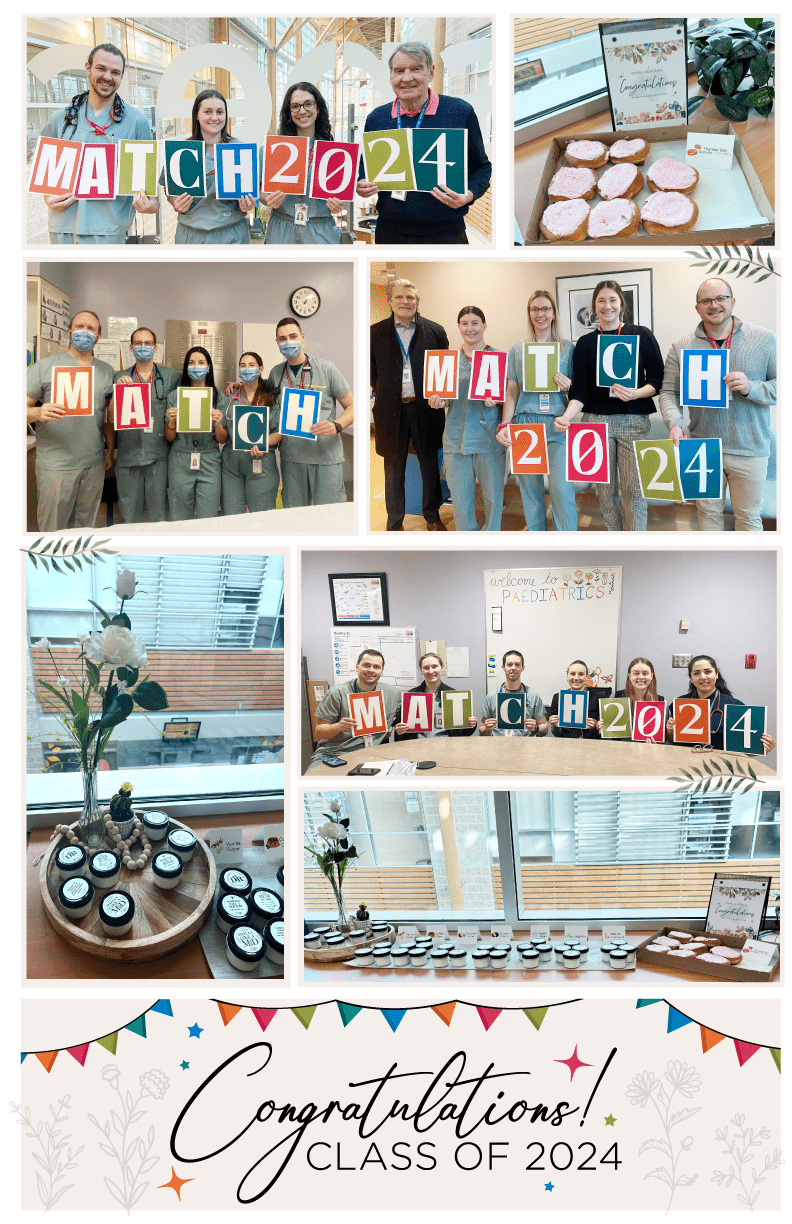
The CaRMS match numbers are in, and we are very excited to share the results: 55% of NOSM University MD graduates chose Family Medicine and half are staying in Northern Ontario.
We are delighted to announce that several graduates from this class will be joining us as residents this July.