
Shared on behalf of Aaron Bruno, Project Planner, Capital & Program Development
We are pleased to inform you that the construction of the new doors within the 2nd level ‘A’ service corridor has been successfully completed.
Kindly note that these doors will remain locked at all times, restricting public access. Staff members can unlock the doors using their hospital badges, followed by the touchless hand swipe to automatically open the doors if necessary.
For patients and visitors accessing departments other than Renal, or trying to exit the Hospital through this corridor, signage will direct them to use the main entrance.
We appreciate your cooperation and patience throughout the construction period.
The biography of Anishinaabe trans Knowledge Keeper, Mona Hardy, Lost Between The Cracks is the tale of resilience, determination, and the space between two cultures. Follow Mona from her childhood to the end of her life, from the remote forests of Northern Ontario to the big city and back, in this rich tale of adventure, love, advocacy, and more.
As a long-serving volunteer, Mona dedicated over 10 years of her life to the Thunder Bay Regional Health Sciences Centre (TBRHSC) and Thunder Bay Regional Health Sciences Foundation (TBRHSF). Her exemplary dedication displayed the essential role volunteers fulfill to help ensure patients have the best experience possible. Mona advocated for a strengthened relationship between patients and professional staff by providing input on policies and processes.
Lost Between The Cracks is a true story, told through Mona’s memories and stories. It will make you laugh, make you cry, and make you look for the people in your life who have been lost between the cracks, in between cultures, who just need a lucky break or a helping hand.
For more information on Lost Between the Cracks click here!
Shared on behalf of Wayne Taylor Director, Cardiovascular, Medicine & Renal Program
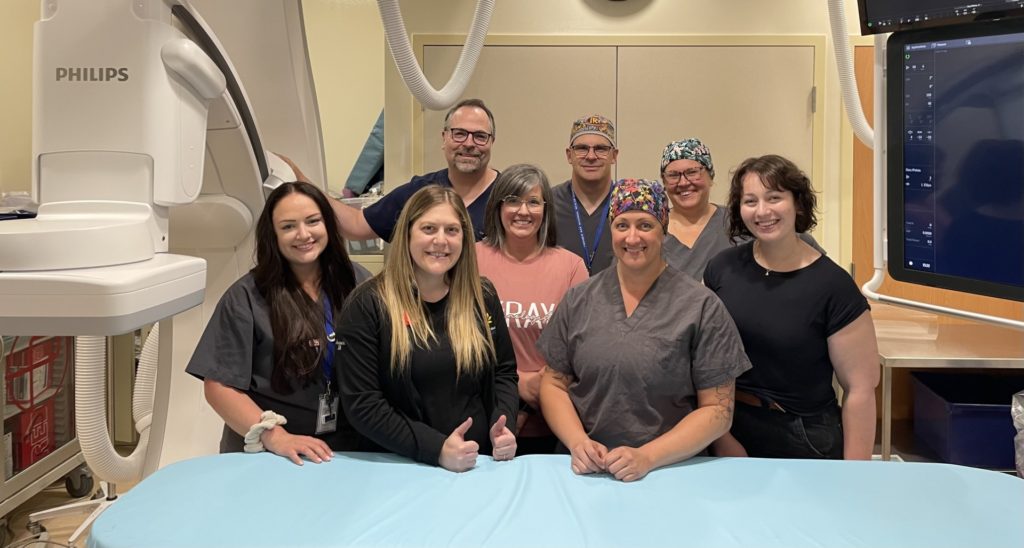
I am pleased to announce that Matthew Shonosky has accepted the position of Manager, Cardiac Catheterization Lab, Pacemaker Clinic & Visiting Specialty Clinics.
Matthew brings over a decade of experience in cardiovascular care and has been the Manager of 2C Cardiovascular and Regional Stroke Unit, Outpatient Vascular Services since 2020. Matthew will begin transitioning into his new role effective Monday, May 20, 2024.
Matthew has worked at the Thunder Bay Regional Health Sciences Centre since 2011. He started at the hospital as a registered nurse on 2C before transitioning to the roles of Utilization Coordinator for 2C and the Transitional Care Unit (TCU), as well as acting Manager for the TCU. From there he took on the role of Manager of 2A Medicine, the Hospital Elder Life Program (HELP) and Telemedicine before finally taking on his current leadership role as Manager of 2C in 2020.
Over the years, Matt has successfully collaborated with multidisciplinary teams to ensure positive results that have improved staff satisfaction and ensured high quality care for our patients and their families. In this new position, Matt’s continued focus on accountability and commitment to quality will be a valuable asset to the teams he supports while staying true to our vision, mission and values.
Efforts are now underway for the recruitment of a successful replacement for Matt in his current role.
Please join us in welcoming Matthew to his new position.
Shared on behalf of Adam Vinet, VP Patient Experience, Chief Nursing Executive and RVP, Regional Cancer Centre
With Laura Lee Barrie’s impending Winter 2025 retirement, I am pleased to announce the appointment of John Ross as the Director, Surgical & Ambulatory Services, beginning in 2025.
Reporting to myself, John will be responsible for optimal patient care and the delivery of high quality service within the Surgical & Ambulatory Services portfolio.
In his role John will work to advance Strategic Plan 2026 priorities, including Seamless Transitions and Evolution of PFCC, while managing a busy and complex portfolio.
John is well known to the staff and professional staff at TBRHSC as the current Director, Patient Flow & Partnerships, a role he has held since 2018. In 2020, John was appointed the Planning Head on the hospitals COVID-19 Incident Management Team and later led the IPAC and Situation Unit. In John’s current role, he has implemented multiple initiatives to improve patient flow and help patients receive the right care, at the right time.
Within our institution prior to his role as Director, Patient Flow & Partnerships, John started as an RN in the Emergency Department (ED) and then advanced through various leadership roles such as the ED Charge Nurse, ED Quality Nursing Clinical Coordinator, Corporate Patient Flow Manager and ED Manager.
Please join me in congratulating John and wishing him well in this new role.
There is not a day that goes by without our physicians going above and beyond to care for our patients and build a healthier community. In recognition of their commitment to patients and the entire health care system, National Physicians Day is celebrated on May 1st. This designated day for physicians provides an opportunity to recognize the dedicated and compassionate care that physicians provide.
This year on National Physicians’ Day, we reflect on the work and sacrifices made by physicians and express our most sincere appreciation for the care they provide in normal and in extraordinary times. Our physicians demonstrate exceptional skill, professionalism and endless compassion towards others every day. Thank you for your unwavering commitment to care, and your practice. Thank you for saving lives in our community and region; you are truly making a difference every day. Thunder Bay Regional Health Sciences Centre would like to sincerely thank every physician for all that they do and for helping us provide exceptional care for every patient, every time.
April has been a busy month for all of us, and I’m thrilled to share some key updates with you.
Following the recent Town Hall and the Ontario Budget announcement in late March, we are optimistic about potential boosts to our financial situation. These enhancements could significantly support our capital projects, which are crucial for advancing our care and attracting top talent to our Hospital and Health Research Institute. We’re actively engaging with Ministry officials visiting our facilities to discuss our unique community needs. Stay tuned for more developments.
During National Volunteer Week (April 14-20), I had the opportunity to shadow two of our dedicated volunteers at the Cancer Centre. This experience brought a refreshing perspective to the administrative side of my duties and reinforced the critical role of our volunteers. A heartfelt thank you to every volunteer who brightens our patients’ days.
Staff Experience is important to Patient Experience, and both are pillars of our Strategic Plan 2026. I want you to know that when you provide feedback related to your work at our Hospital or Health Research Institute, we are listening. In response to your feedback and engagement surveys as well as our work with the Staff Advisory Committee, I would like to inform you about the organizational level actions that we have been working on to improve your work experience:
Food Services: We’ve broadened food options and extended service hours. Notable changes include extended cafeteria hours for hot meals and salads, Robin’s shifting to 24 hours service and starting May 2024, Robin’s will offer “Grab & Go” options to their 24 hour service. We anticipate positive feedback regarding these changes — please feel free to let us know.
Staff Spaces: Following an audit and survey of our break spaces through our Staff Advisory Committee, we’re standardizing and enhancing these areas. Expect upgraded amenities like kitchen equipment across all breakrooms, maintained as per new policy standards. Additionally, a new / enhanced staff break space will be developed on the 3rd floor by the Sim Lab, with renderings coming soon! Expect this to be completed this fall.
Staffing Enhancements: In response to increased bed capacity, we are boosting our nurse and support staff numbers. This enhancement will improve patient experience and provide better outcomes for both patients and staff. We are also launching new recruitment initiatives for positions where resources can be more difficult to find, like those in our labs and pharmacy.
So, again, please know that we’re listening. Your feedback is invaluable. Keep sharing your thoughts through the Staff Advisory Committee email or directly with your manager.
Finally, I would like to follow up on some comments and questions regarding our in-house security protocols. After seeing a reduction in violent incidents in the Emergency Department this past year we have extended the Thunder Bay Police Service paid duty contract. We know one case of violence is too many and this is why we need to continue to ensure heightened security during peak times. At the same time, we are exploring other opportunities and partnerships to create a more diverse and sustainable model for long term safety solutions both within the Emergency Department and the broader Hospital environment. Thank you for your efforts to support this work. We will keep you updated as to our progress.
As always, I’m open to your thoughts on this blog or any other topic. Contact me at rhonda.ellacott@tbh.net. I look forward to hearing from you.
Thank you for your continuous dedication and hard work.
Province to spend $45 million over three years on the program, upping the hotel accommodation rate and removing a 100-kilometre deductible for mileage reimbursement.
Health Minister Sylvia Jones (centre) speaks on Tuesday, April 30, 2024 at Thunder Bay Regional Health Sciences Centre about changes to the Northern Ontario Health Travel Grant program, as Hospital CEO, Dr. Rhonda Crocker Ellacott and Patient Family Advisor Paul Carr, MPP for Thunder Bay-Atikokan Kevin Holland look on.
Health Minister Sylvia Jones on Tuesday revealed details of the revamped plan at a stop at Thunder Bay Regional Health Sciences Centre, announcing they have increased the overnight accommodation allowance from $100 a night to $175, and from $550 to $1,050 for stays of eight nights or longer.
The government also reduced the travel distance requirements from 200 kilometres round trip to 100 kilometres and have expanded the eligibility to cover costs of medical travel companions accompanying a patient requiring hospitalization.
The province plans to provide $45 million over three years to fund the program.
Jones said the goal is to provide Northern Ontarians with a better health-care experience, acknowledging residents often don’t have access to a full suite of medical services in their home communities, especially in sparsely populated regions in the Northwest.
That shouldn’t mean accessing health care needs to be a financial burden, the minister said, calling it another step toward connecting people in the region to the specialized health care they need.
“These programs provide financial reimbursement that helps cover the medical related costs Northern Ontario residents have incurred while travelling to access OHIP-insured health-care services that are not available within a 100-kilometre radius of where they live,” Jones said.
“The province will begin implementing expansions and needed improvements to the Northern Health Travel Grant program starting this fall.”
The changes will also include a more convenient, online application form, that includes digital receipt submission capabilities, allowing for faster reimbursements and eliminates the need for a signature from a referring physician or health-care provider.
The expansion also adds more health-care partners to the program, as well as community labs, to help more people get reimbursed for their costs.
“(We’ve also) removed the 100-kilometre deductible so people can get reimbursed for every kilometre travelled, to offset higher gas prices. These changes are also increasing reimbursements for overnight trips, to better reflect people’s needs and increased costs,” Jones said.
Paul Carr, a patient advocate at Thunder Bay Regional, said he welcomes the new changes, noting the care needed, including cardiac surgery, isn’t always available close to home.
“Sometimes (patients) face many barriers in terms of accessing care. When you have to travel long distances to attend appointments or receive specialized care or surgeries, it would be great if patients could access the same level of care and services throughout the province, but we know that’s not the case right now,” Carr said.
“Some of our patients have to travel for excess care and this can be a daunting experience. For some it might be the first time they’ve ever travelled to an urban centre.”
Every little bit helps, Carr said.
NDP MPP Lise Vaugeois applauded the changes, calling the move good news for Northern Ontarians, in particular the removal of the 100-kilometre deductible for the gas repayment. However, Vaugeois said the province could have gone further and increased the mileage rate from the current 41 cents a kilometre.
“I think we get roughly 61 cents a kilometre as MPPs,” Vaugeois said. “It’s miles from where it needs to be to cover the cost.”
She added the hotel accommodation rate falls a bit short of the actual cost of rooms, especially in centres like Toronto.
The spending was previously announced in the 2024 Ontario budget.
Stigma is a significant barrier to wellness and good health for people who use substances.
The Canadian Centre on Substance Use and Addiction (CCSA) designed Overcoming Stigma Through Language: A Primer to increase understanding and start conversations around the devastating stigma associated with substance use and addiction and its impact on the well-being of people touched by this health issue.
This Primer was created with support from CCSA’s partners at the Community Addictions Peer Support Association. The goal of this primer is that it will help to recognize the stigmatizing language, attitudes and behaviours that surround people experiencing the harms of substance use.