Downtime Notice: Network Services (July 25-26)



The Regional Clinical Placement Coordinator Initiative is looking for feedback from preceptors to help shape learner experiences across Northwerstern Ontario. This will help to determine what’s working well, challenges/barriers that exist, and opportunitiesto provide support.
Regional Clinical Coordinators will be on site July 16 from 10 a.m. – 2 p.m. at the bottom of the Grand Staircase. Stop by for a refreshment and a chance to talk about your experiences.
Take a moment to complete a survey for your chance to win a YETI Cooler!
See the poster below for more information.

Please come down and celebrate National Hot Dog Day at Flavours Café Wednesday, July 15. See poster below for details.

The Canadian Mental Health Assocation will be on-site to host two workplace mental health workshops.
Date: July 15
Time: 1 p.m – 2 p.m. & 2:05 p.m. – 3 p.m.
Location: ICP Main, Room 2178
Session 1 (1 p.m. – 2 p.m.) Stress at work: Health care workers face daily challenges that can take a toll on
well-being and performance. In this webinar, participants will examine the unique stressors experienced by health care workers and explore practical strategies for addressing workplace stress.
Sesssion 2 (2:05 p.m. – 3 p.m.) Consideration & Collaboration at Work: Civility and Respect are essential psychosocial factors that support well-being at work. This webinar
introduces the SALSA approach, which participants will apply to address communication barriers and build consideration and collaboration in the workplace.
To register, or for more information, email: TBRHSC.OccupationalHealthandSafety@tbh.net.

Afro Vibe Fest is Thunder Bay’s first Afro-centric arts and music festival, celebrating the vibrant rhythms, culture, and diversity of Afro music, arts, and community. The festival aims to promote cultural inclusion and diversity while celebrating Afro culture and fostering community connections.
Highlights of the festival include a colourful parade, African cultural performances, reggae and Afro music, local DJs, dancers, drummers, spoken word artists, and a Kid’s Corner with games and face painting. There will also be local vendors and organizations, and food booths offering Afro-inspired cuisine and a variety of other options.
The festival will take place on July 11 & 12 at Marina Park, and opens each day at 12:00 p.m.
Thunder Bay Regional Health Sciences Centre will have a booth at Afro Vibe Fest to engage the community on the Black Health Action Plan.
For more information, or to purchase tickets, please go to: https://www.afro-vibefest.ca/home
Please be advised that the TBRHSC Dual Code site will undergo a scheduled upgrade on Monday, July 13. As a result, Dual Code e-learning and Coaching for Development will be unavailable beginning at 8:00 a.m. for approximately 2.5 hours (or less) while the upgrade is completed.
As Pride Month 2026 has come to an end, the 2SLGBTQQIA+ Subcommittee and Pride Working Group would like to extend our heartfelt thanks to the staff of Thunder Bay Regional Health Sciences Centre for participating in Pride Month events, and supporting the 2SLGBTQQIA+ community.
Thank you to everyone who participated in Pride Month Trivia. The winners for each week are listed below:
Week 1: Terah White
Week 2: Alison Donovan
Week 3: Nancy Maijala
Week 4: Barb Warpula
Week 4 Answers
Below are the answers to the fourth and final week of Pride Trivia.
Question 1: What does 2S stand for in the 2SLGBTQQIA+ acronym?
Answer: 2S in the 2SLGBTQQIA+ acronym stands for Two-Spirit. The term Two Spirit is a culturally-specific identity describing Indigenous individuals whose gender, spiritual, or sexual identity includes both male and female spirits. The term honors gender and sexual diversity and emphasizes the ability of Two-Spirits to navigate both worlds and hold male and female responsibilities in their communities. While the concept of Two-Spirit individuals has existed among Indigenous Peoples for generations, the term niizh manidoowag, meaning “two spirits,” was first proposed in 1990 by Elder Myra Laramee.
Question 2: In 1998, Glen Murray became the first openly gay mayor of a major city in North America. What city was he mayor of?
Answer: In 1998, Glen Murray was elected as the mayor of Winnipeg. He was the first openly gay person to be elected mayor of a major city in North America, a position he held from 1998 to 2004.
Question 3: What is the name of Canada’s largest and longest-running queer theatre company?
Answer: Established in 1979 in Toronto, Buddies in Bad Times Theatre is recognized as the worlds largest and longest-running queer theatre company. It serves as a major hub for queer artistic expression in Canada, focusing on developing new works and supporting LGBTQ+ artists.
Question 4: What are some ways that you can be an ally to the 2SLGBTQQIA+ community? (Check all that apply).
Answer: There are many ways to demonstrate allyship with the 2SLGBTQQIA+ community, therefore all responses are correct. You can:
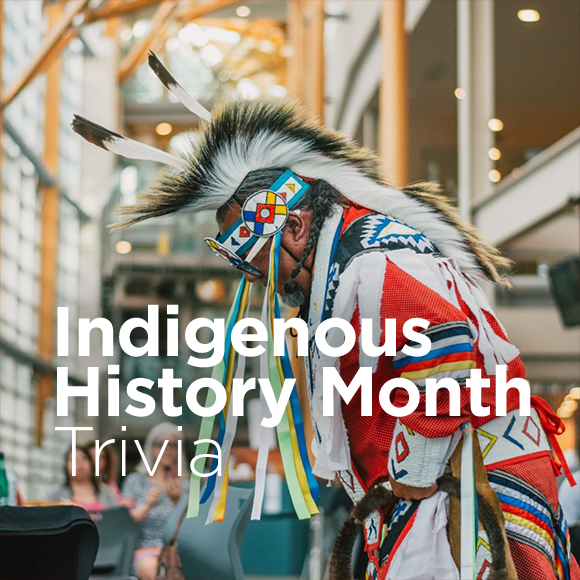
Miigwech (thank you) to everyone who took part in our National Indigenous History Month trivia challenge!
We hope these questions provided an opportunity to learn more about Indigenous history, the impacts of colonization on health and wellness, and the ongoing journey toward reconciliation in health care. Building awareness and understanding is an important step in creating culturally safe, respectful, and inclusive care environments for all.
The answers to the trivia questions are listed below.
Q 1. Before colonization, how did many Indigenous Peoples traditionally view health and wellness?
Answer: A balance between physical, emotional, mental, and spiritual wellbeing
Q 2. What federal legislation, passed in 1876, gave the Canadian government extensive control over many aspects of First Nations life?
Answer: The Indian Act
Q 3. During what years did the Canadian Indian Residential School System operate?
Answer: 1883-1996
Q 4. What did the Truth and Reconciliation Commission’s healthcare-related Calls to Action encourage healthcare organizations and professionals to do?
Answer: Recognize the impacts of residential schools, address systemic racism, and support culturally safe care