An important update has been released for the Heart & Stroke Canadian Stroke Best Practice Recommendations (CSBPR): Secondary Prevention of Stroke Update 2020, replacing the previous update released in 2017. Stroke remains a leading cause of adult neurological disability, dementia and death globally.
The updated secondary prevention recommendations provide updated evidence and guidance for some existing recommendations. Significant revisions and new recommendations had been made in the following areas:
Simplified recommendations for triage and initial assessment of acute TIA and minor stroke.
Revisions to stroke workup.
Updated recommendations for dual antiplatelet therapy for TIA and minor stroke; anticoagulant therapy for atrial fibrillation; embolic strokes of undetermined source; LDL lowering; hypertriglyceridemia; diabetes treatment; and PFO management.
New sections have been added around guidance for temporary interruption of antithrombotic therapy for surgical procedures, and cancer-associated ischemic stroke.
Sex differences are addressed where appropriate.
A section on virtual care delivery of secondary stroke prevention services in included to highlight a shifting paradigm of care delivery made more urgent by the global pandemic.
For more information about the Heart & Stroke Canadian Stroke Best Practice Recommendations visit: www.strokebestpractices.ca
Please see the archived Provincial Stroke Rounds which reviews the Canadian Stroke Best Practice Recommendations Secondary Prevention of Stroke Update 2020 Click the Link: https://youtu.be/QulKJZ7X1DU
The Northwestern Ontario Regional Stroke Network Thunder Bay Regional Health Sciences CentreMedical Centre, 201-984 Oliver Road Thunder Bay, ON P7B 7C7 phone: (807) 684-6703 fax: (807) 684-5883For more information, visit www.nwostroke.ca
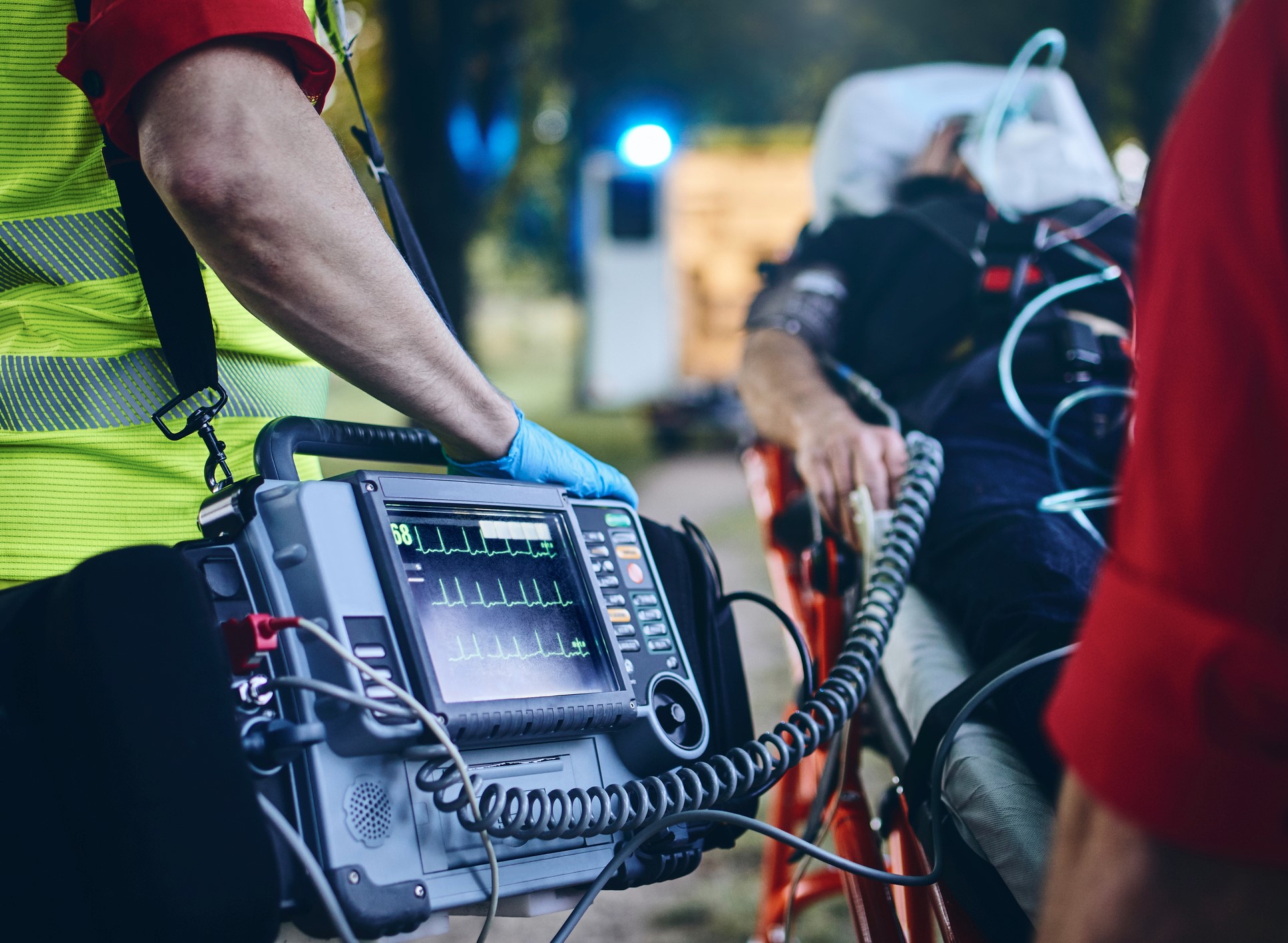
Thunder Bay Regional Health Sciences Centre (TBRHSC) in collaboration with local EMS services was awarded top marks in Ontario for their outstanding work in the areas of ST Elevation Myocardial Infarction (STEMI) care. The honours were handed out by CorHealth Ontario, the overseeing body for cardiac, stroke and vascular care in the province.
The STEMI Program is comprised of first responders, paramedics, emergency department physicians and nurses, interventional cardiologists, cardiac catheterization lab nurses and administrators. The system has to flow for the patients to receive exceptional care during their heart attack.
“Thunder Bay is leading the way when it comes to patient care and we are the best in Ontario due to the hard work, dedication and amazing talents that we have in our region,” said Dr. Rhonda Crocker-Ellacott, TBRHSC’s President & Chief Executive Officer. “Teamwork and a strong respect between Hospital staff and EMS ensures our patients are getting the highest quality care, and the fastest across all of Ontario. This recognition is all theirs.”
TBRHSC is the only PCI (Percutaneous Coronary Intervention) capable hospital in Northwestern Ontario that can treat a patient’s heart through angioplasty. Angioplasty is a specialized procedure performed by a specialist called an interventional cardiologist, to open up a coronary artery which is narrowed due to plaque build-up. The procedure will widen blocked or partially blocked arteries, usually with a balloon. In most cases, one or more stents are used to help support the artery.
“When our patients call 911, the goal is time; the faster a cardiac event is discovered on an ECG, the better the treatment outcome,” said Meaghan Sharp, Director, Cardiovascular Sciences and Chief Nursing Executive, TBRHSC. “Our patients receive care from a paramedic and in many cases have a first responder as their first medical contact due to our geography. Once the paramedics are with the patient, they are able to perform a 12-lead ECG to determine the severity of the heart attack – activating Code STEMI protocols.”
The Code STEMI program links Superior North Emergency Medical Services paramedics and an interventional cardiologist within the Thunder Bay District 24 hours a day, 7 days a week.
Sent on behalf of Dr. Peter Voros, EVP In-Patient Care Programs
Effectively immediately, the Personal Protective Equipment (PPE) guidelines around eye protection at our Hospital has been updated.
With the low number of COVID-19 positive cases in the community and in our Hospital, rising vaccination numbers, and based on recently updated Ministry of Health guidelines, protective eyewear will now only need to be worn in clinical areas (inpatient and outpatient) or when providing patient care in a non-clinical area within 2 metres.
Masks will continue to be worn by everyone entering our Hospital and all satellite locations (1040 Oliver Road, Munro Street locations, the Transitional Care Unit at Hogarth Riverview Manor, the Medical Building, the COVID-19 Assessment Centre, and the Bora Laskin COVID-19 Vaccination Clinic) at all times with the only current exceptions being when someone is in a designated eating area or when they are alone in an office.
Please contact your manager with any questions or concerns.
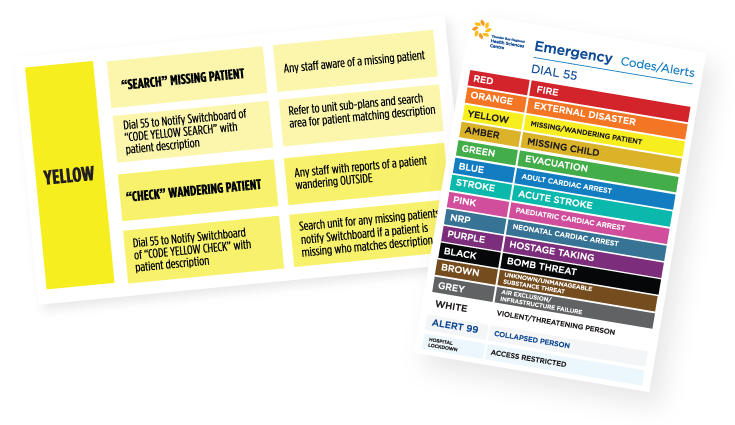
The Hospital’s Code Yellow—Missing or Wandering Patient policy (EMER-70) has been revised and will be implemented July 7th 2021.
Actions required:
Managers:
Circulate this memo to your staff.
Update and submit Code Yellow sub-plan to Lori Siver, Administrative Assistant, Cardiovascular Sciences Program (siverlo@tbh.net) no later than July 23rd, 2021 using that attached sub-plan template. To complete the template, fill in the information that is highlighted. All other content is to remain as is.
Print the updated policy and sub-plan and add them to the area’s emergency binder, remove/recycle previous versions of the policy, and distribute updated policy and sub-plan to staff for review.
Print and utilize Code Yellow Safety Huddle resource.
Interprofessional Education will be in contact with managers to coordinate education for Code Yellow within departments.
Staff/Professional Staff:
Read this memo to familiarize yourself with important process changes.
Review the Code Yellow—Missing or Wandering Patient policy (EMER-70) and department sub-plans. Contact your manager with any questions.
Significant policy changes:
Applies to all patients 16 years and older. For a missing or abducted infant or child, refer to Code Amber policy.
New definitions and processes:
High Risk Patient: A patient who is considered to be at high risk for personal injury or negative outcomes related to their unknown whereabouts. Cognitive impairment may be a factor, but many conditions/circumstances contribute to an individual’s risk status.
Only patients who meet the criteria for a High Risk Patient will trigger a Code Yellow Search
Separate process within Code Yellow policy for Not High Risk Patients
Admitting to call all units for inspection results.
Senior Leader on call notified in the event of a Code Yellow Activation.
Process Reminders:
Code Yellow – Search: A Hospital-wide response to search for a high-risk patient (age 16 years or older) that is missing from within the Hospital and there is reason to believe they are on Hospital grounds.
Code Yellow – Check: A Hospital-wide response to support the identification of a wandering patient(s) (age 16 years or older), who appears to be high risk and unaccompanied, found on or nearby Hospital property.
Wandering patient: A person that is believed to be a high risk patient who is wandering unaccompanied on or near Hospital grounds.
Unless a patient is at immediate risk to themselves, dial “0” to have to patient paged (first name, last initial) to return to unit/ department. Wait 5 minutes. If the patient has not returned, and is considered to be High Risk, dial “55” to activate a Code Yellow Search.
For questions, please contact Morgan Reilly, Lead, Emergency Preparedness reillym@tbh.net ext. 6552
Sent on behalf of Dr. Peter Voros, EVP In-Patient Care Programs
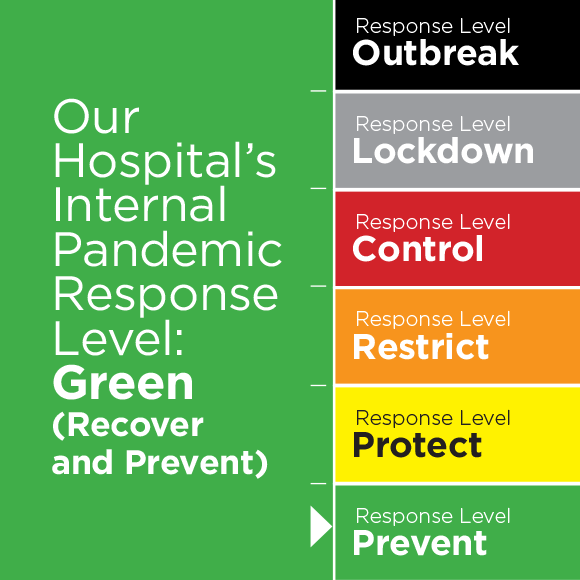
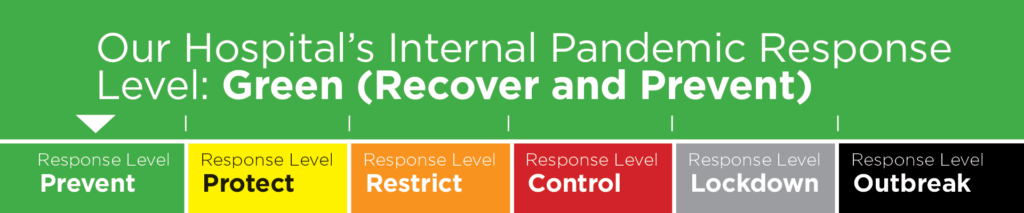
Effective immediately, our Hospital has moved its Internal Pandemic Responsive Level from Yellow (Protect) to Green (Recover and Prevent). This is a result of the low number of COVID-19 positive cases in Thunder Bay and across Northwestern Ontario, and the rising vaccination numbers in our community.
Please note that moving to Response Level Green does allow us to reduce restrictions on learners, volunteers as well as our external partners. In particular, all contractors and vendors who provide technical support, suppliers, and sales people will be allowed on site by invitation only.
Despite the move to Green, we must continue to be cautious with our COVID-19 pandemic response. The safety of patients, staff and the community remains our utmost priority. With variants of concern circulating throughout the province, there is the possibility that the situation can change quickly. Entrance screening, physical distancing, and PPE guidelines will remain in place for everyone entering our Hospital.
The past year has been extremely challenging for the health-care profession. Health-care workers are experiencing increasing rates of anxiety, depression, stress, and burnout due to the pandemic. Still, the staff, professional staff, and volunteers at the Thunder Bay Regional Health Sciences Centre (TBRHSC) continue to show remarkable resilience and dedication, showing up to work every day ready to provide exceptional care to our patients. With this in mind, Prevention and Screening Clinical Services at TBRHSC developed the Undercover Kindness Mission to spread kindness throughout our hospital, boost morale, and let their colleagues know that their hard work has not gone unnoticed.
“With pandemic restrictions in place, we have been unable to hold on-site or in-person wellness events for staff. The Undercover Kindness Mission seemed like the perfect opportunity to reach both clinical and non-clinical staff,” says Kelly-Jo Gillis, manager of preventive health services at TBRHSC. “During times of stress and change, it’s important not to forget or overlook the importance of being kind. One small act of kindness can make someone’s day, and at the same time, contribute to creating a culture of kindness in our hospital and community.”
The Undercover Kindness team, consisting of five staff members, began writing kind, heart-shaped notes, providing words of encouragement and thanking the staff for everything they do. These handwritten notes were placed randomly on the windshields of cars in the hospital staff parking lots, sent through interoffice mail, and taped in other public locations to be found by unsuspecting staff members.
Sabrina Karpowich, the administrative assistant for adult and forensic mental health at TBRHSC, was the recipient of one of these anonymous notes. She may not have known who it came from but it impacted the rest of her day. “It had been a busy day and I was looking forward to going home to unwind. As I got to my vehicle, I saw the note under the windshield wiper. Reading it instantly brought a feeling of comfort and relief,” says Karpowich. “Times have been tough over the last 15 months. It meant a lot to see that people are still showing compassion for others. It also inspired me to pay it forward because I wanted someone else to feel the same happiness and love that I felt receiving the note.”
The message spread far beyond this single piece of paper when Karpowich shared pictures of the note on Facebook and Instagram. “Not only did the note bring me happiness in that moment, but I was so excited to share with others on social media,” she says. “I was overjoyed by the sweet comments I got in response. It’s nice to feel appreciated.”
Since April, notes have been appearing around the hospital for both visitors and staff. Each note is slightly different but they all encourage the recipient to pay it forward. To date there have been hundreds of notes distributed. The group is hoping that this initiative will spread to other businesses and across our community, creating a culture of kindness in a time where we can all benefit from it.
Acts of kindness don’t go unnoticed and they can have a huge impact on the overall positivity of a workplace or community. Often, we walk by those who feel disconnected from the world, lost and alone. Random acts of kindness, like these heart-shaped notes, have been proven to boost our mood and mental health. They can make people feel connected, give them a sense of purpose, and let them know that they are appreciated. They can also be exactly what you need at the end of a long day.
Write a kind or motivational message and remind the recipient to pay it forward
Decorate the heart and cut it out
Leave the heart for a friend, coworkers, family member, or stranger to find
Remember, spreading kindness is not limited to these heart-shaped notes. It can even be as simple as saying hello to a stranger, holding the door open, or wishing someone a great day. Sometimes it’s the smallest gesture that can have the biggest impact on someone’s day.
Amanda Walberg, Project Assistant, Prevention and Screening Services at TBRHSC.
Responding to a major public health crisis like the COVID-19 pandemic has meant a lot of work for the local health care system. The Thunder Bay Regional Health Sciences Centre has had to adapt to everything from building a specialized ward for COVID-19 patients and implementing screening protocols to changing cleaning and disinfecting procedures—all the while working to fulfill its usual role as the primary hospital in the northwest.
The COVID-19 incident management team at the Hospital, consisting of the organization’s top medical and administrative personnel, has been responsible for leading the facility through the past 16 months. Large administrative bodies, however, also need crucial support, and that’s where Amanda Walberg comes in. She’s the self-described “scribe” for the team, and fulfills many roles, like scheduling and preparing materials for meetings, documenting decisions, circulating the numerous information reports, and tracking expenses, as well as providing similar support for the planning and logistics subsections of the management team. Matt Prokopchuk spoke with Amanda about her role.
The Walleye: How big of an undertaking has all of this been?
Amanda Walberg: When COVID was surging, it was really hands-on [with] tight deadlines, and we needed to take everything to action right away and be timely with everything. There are some times where it really was COVID-dependant. I’ve been involved since October and it’s always been a hands-on, very timely and intense role for sure. […] We’re always looking at our region as well as the province and how to help, so it’s always been a very hands-on position.
TW: Take me to one of those “surge” days. What was that situation like?
AW: We have a super high-functioning team, so everyone would drop everything to meet whenever it was needed and when decisions needed to be made. I would work with the incident manager really closely to make sure everything that we needed was ready. There might be a follow-up meeting right after a big IMT [incident management team] meeting where a smaller group needs to take care of something, and I would be involved in all of that. So, just making sure things aren’t forgotten and that everything was taken care of for the hospital.
TW: What sorts of things are you making sure you don’t forget?
AW: Really, you don’t want to forget anything [laughs]. But you’re keeping an eye on triggers and actions that come from the meetings and you don’t want to not follow up on any of the actions. They’re all big decisions that are going to benefit our hospital and our community, so [you’re] making sure that if you need to clarify with the team that we’re all on the same page and not letting anything slip, which everyone’s done an extremely good job of doing.
TW: What do you feel you’ve learned from this experience?
AW: Honestly, I’ve learned so much, I’ve only been at the hospital for under two years, so just understanding how the hospital functions and how […] things involve not only just one department, [but] everywhere. It’s been such a valuable experience to work with the leaders of the hospital and everyone’s so dedicated, and it’s a very motivating and valuable experience.
Sent on behalf of Dr. Peter Voros, EVP In-Patient Care Programs
Based on monitoring of the evolution of the COVID-19 pandemic, and in alignment with the Thunder Bay District Health Unit, the Ontario Ministry of Health, and Federal directions, travel restrictions will change for everyone entering our Hospital.
Effective Tuesday, July 6th, 2021 at 0600, and in alignment with the Federal Government changes to travel outside of Canada, the COVID-19 screening question about travel will be updated to: “Have you traveled outside of Canada in the last 14 days? (Answer NO if you have been cleared by OHS or ArriveCAN has exempted you from quarantine)”.
This will be the only travel question on screening – the question regarding travel outside of Northwestern Ontario (Manitouwadge to the Manitoba Border) will no longer be asked.
Please note that until this change comes into effect, those who travel outside of Northwestern Ontario, including this long weekend, must be fully vaccinated to return to work without isolation.
To be considered fully vaccinated by OHS, you must:
have received the full series of an accepted COVID-19 vaccine or a combination of accepted vaccines (Pfizer, Moderna, AstraZeneca, Janssen (Johnson & Johnson))
have received your last dose at least 14 days prior to travel
provided your proof of vaccination to OHS
Further changes or adjustments to the above guidelines may be required as the COVID-19 pandemic evolves. Thank you for your cooperation and commitment to safety.
The Patient Clothing Cupboard is in need of new or very gently used men’s and ladies’ loose fitting sweatpants, and brand new socks and underwear for men and women.
Please drop them off in the Volunteer Services office during the week, Monday to Friday 8:00 am to 4:30 pm.
Thank you. Your generosity is greatly appreciated.
Shared on behalf of Dr. Peter Voros, EVP In-Patient Care Programs
As of June 30th, the Virtual Emergency Department (ED) pilot at our Hospital has ended.
Launched on January 4th, 2021, the Virtual ED offered same-day virtual assessments with emergency department physicians. The program was made available to people living in Thunder Bay and the surrounding area who are older than 17 years of age, have a non-life-threatening medical issue, and either don’t have a primary care provider or are unable to obtain timely access to one.
Patients and families in our community embraced this innovative and convenient care option. As of June 30th, 815 virtual appointments were completed and the overall patient experience was rated a 9/10 by those who utilized the service.
The Virtual ED was also successful at reaching those who needed it most:
36% of people who utilized this service had no Primary Care Provider (PCP).
A variety of non-urgent medical conditions were treated, including 25% who required a prescription and 13% who were referred to the ED for further assessment.
The most common reason for seeking this virtual option was related to the inability to obtain a timely PCP appointment.
Thank you to all those involved who made this service a reality for our patients and their families. Our Hospital will look for collaborative opportunities to offer virtual care in the future.