Join us on December 10 at Goods & Co for our Dream Land on the Bay special event.
Organized by Olivia Moore and Krystianne Cabanayan, this event aims to make dreams come true for the children in our community. From 11:00 a.m. to 4:00 p.m., you can book slots for photographs with Disney Princesses.
Dream Land on the Bay is more than just an event; it’s a celebration of hope, compassion, and the spirit of giving. Our goal is to create a magical experience for children during the holidays, providing them with moments of joy and inspiration.
By attending this event, you will directly contribute to enhancing the services and resources available at the TBRHSC Paediatric Department and the George Jeffrey Children’s Centre.
Don’t miss out on this opportunity to support a great cause and make a difference in the lives of children in our community. Book your photo time slots through the link below and see you on December 10!
Shared on behalf of Infection Prevention and Control
Please be advised that the COVID-19 outbreak has been declared over at Transitional Care Unit as of December 1, 2023. All restrictions have been lifted.
Please share this information with the appropriate staff.
For more information, contact Infection Prevention and Control at 807-684-6094.
Parenting, like life in general, is a balancing act. As a parent, you may wonder if you are nurturing enough or not enough, if you are too strict or too lax, too giving or too withholding.
Finding the healthy balance in your parenting style is not an easy task, however setting limits and having expectations of your child shows them that you care. You are nurturing their emotional health, providing them with the opportunity to manage their behavior and emotions from an early age and thereby preparing them for adulthood.
For more resources on healthy living or to learn more about TBRHSC’s Paediatric Healthy Living Program, please visit our website at bit.ly/Paediatric-Healthy-Living-Program.
As we head into the holiday season and approach the end of the calendar year, I know this is a very busy time for all of you, so I wanted to touch base with a quick update.
I would like to begin by thanking everyone who completed the 2023 Employee and Professional Staff Engagement Survey. Please note that we have extended the survey until December 3rd and we would truly appreciate your participation. The insight gained from your feedback will allow us to build on the successes and identify areas where improvement can enhance the work culture. We hope your participation in the survey gave you an opportunity to reflect and consider what motivates you about work and the connection you have to your role and the organization. We want to make progress when it comes to helping you feel appreciated and purposeful in your work.
We also know patient experience is interwoven with staff experience — and both lead directly to our vision of exceptional care for every patient, every time. At our Town Hall this month we heard a story about a patient that was well supported throughout their journey within our Hospital. Upon hearing the story, I couldn’t help but reflect on the importance of positive staff experience and teamwork. The patient experience is the sum of all interactions, shaped by an organization’s culture where patient perceptions are influenced along the continuum of care. Providing optimal care is rewarding and is better accomplished if we all have a common goal as was evident in this story. The teams worked effortlessly to ensure the patient was taken care of and felt rewarded in their efforts; the outcome was a better patient experience. This is just one example of the great work you are all doing.
A huge congratulations to our Northwestern Ontario Regional Stroke Network (NWORSN) team who was awarded the 2023 RBC Innovation Hero of the Year award earlier this month for the development of the NWO Navigate Application. The interactive app assists health care providers when dealing with time-sensitive conditions when needing to navigate the most appropriate options for stroke care in Northwestern Ontario. The award was accepted by Trina Diner, Manager, NWORSN, Neurology, Cardiac Diagnostics and Cardiac Rehabilitation on behalf of the organizations and people involved in this supportive creation. We are proud of the team and their innovative and collaborative work to support patients in getting essential and timely access to treatment for suspected strokes.
This week we gave back for Giving Tuesday, led locally by our Health Sciences Foundation. This international day is a time to reflect and a chance to give back to patient care beyond our work. I certainly was not surprised by the number of people within our Hospital and Health Research Institute that go above and beyond their general call of duty and contribute back in donations. Thank you to all for making that day such a success to ensure patient care is enhanced through these donations.
Finally, as we continue to encounter increased visits to our Emergency Department due to respiratory-related illnesses, please be mindful of your surroundings and the elevated activity within our community. Please also make certain you are following our masking and IPAC measures within our Hospital to minimize the risk. We appreciate your cooperation and supporting these measures with patients and families.
Thanks for taking the time to read this month’s blog and I trust you will get some time over the coming weeks and take in some holiday cheer with your friends, family and co-workers.
As always, please feel free to reach out to me with comments or for any other matter. You can reach me at: rhonda.ellacott@tbh.net.
Shared on behalf of Nicole Moffett, Manager of Emergency Preparedness, Switchboard and Security
Winter has arrived!
Throughout the winter, our contractor (Thunder Bay Multitrades) will be closing lots at various times to allow for proper snow removal. Please obey all posted signage and park in alternate lots as indicated on the signage.
Please be mindful when parking. Do not block any driving lanes or roadways, and try to line up with existing spots where possible. Do not leave too much room between vehicles as it reduces the number of available parking spots. Please be aware of parking rows to avoid creating a third row, which can block vehicles in. Note that parking enforcement will continue throughout the winter to ensure safety.
Remember that all staff have access to Lot I (also known as the Turtle Lot) throughout the year. If the lot that you are assigned is full, please park in Lot I.
We must cooperate to get through the winter season with minimal disruptions and inconvenience. We appreciate your support!
If you have any questions or concerns, please contact Paul Bishop (Garda World Security site manager) via email or at ext. 6014.
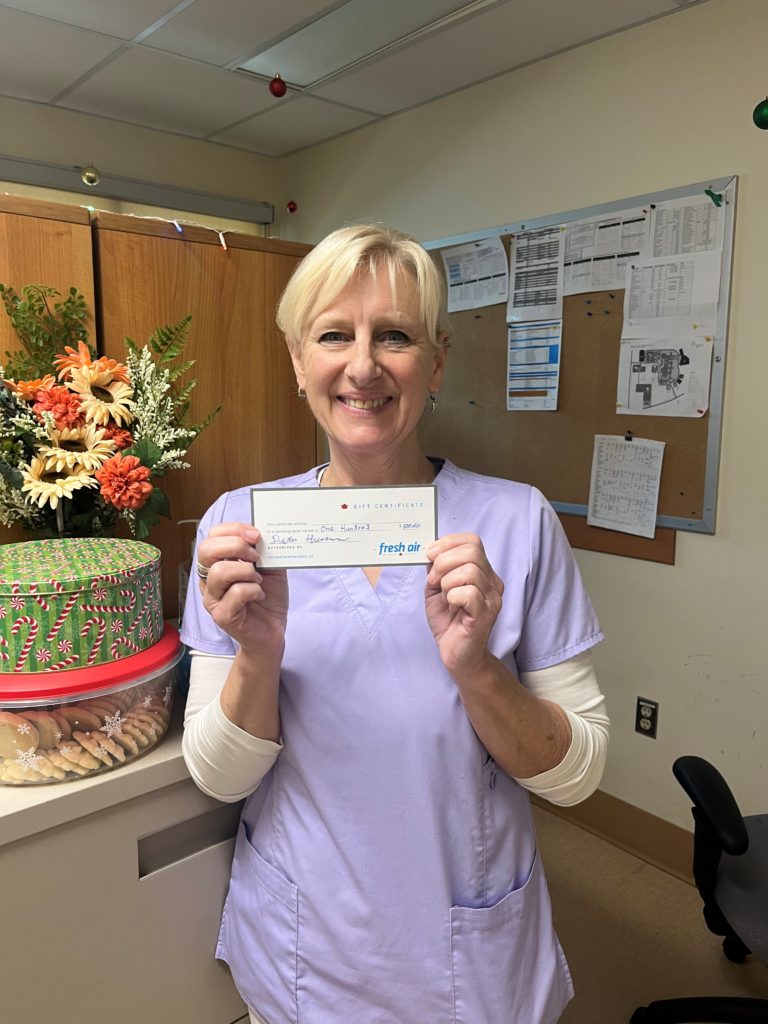
Congratulations to Carolyn Leonzio for being drawn as the latest draw prize winner for completing the Employee and Professional Staff Engagement Survey!
Do you want a chance at winning a draw prize? Don’t forget to complete your survey and share your valued feedback. As of November 29, we are closer to our 75% participation goal at 45% completed!
Shared on behalf of Andrea Raynak – Director, Nursing Practice
I am pleased to announce that Justin Ross has accepted the position of Clinical Nurse Specialist (CNS), Vascular Access.
Justin graduated from Lakehead University with a Bachelor of Science in Nursing, and has spent the majority of his career within the Emergency Department. With over 14 years of acute care and critical care experience, he has demonstrated his ability to prioritize, critically think and to deliver optimal patient care. Justin holds a Canadian Nurses Association Certification in Emergency Nursing and is a Trauma Nursing Core Course Instructor.
Justin has had the opportunity to be the Practice Coordinator for the Nursing Resource Team, and has been the temporary CNS, Vascular Access for the last 7 months. Within this role he has worked on expanding vascular access care, and has explored innovative opportunities for patients of all ages admitted to our hospital.
When not at work, Justin enjoys running and spending time with his family.
Shared on behalf of John Ross, Director – Patient Flow & Partnerships
Please be aware that Katherine Bell, Manager – Infection Prevention and Control has returned and is available for any IPAC related concerns. Please share this with your staff.
I want to thank Hilary McIver for providing interim coverage while Katherine was away. Hilary has returned to her regular Coordinator duties.
Shared on behalf of Andrea Raynak, Director Nursing Practice
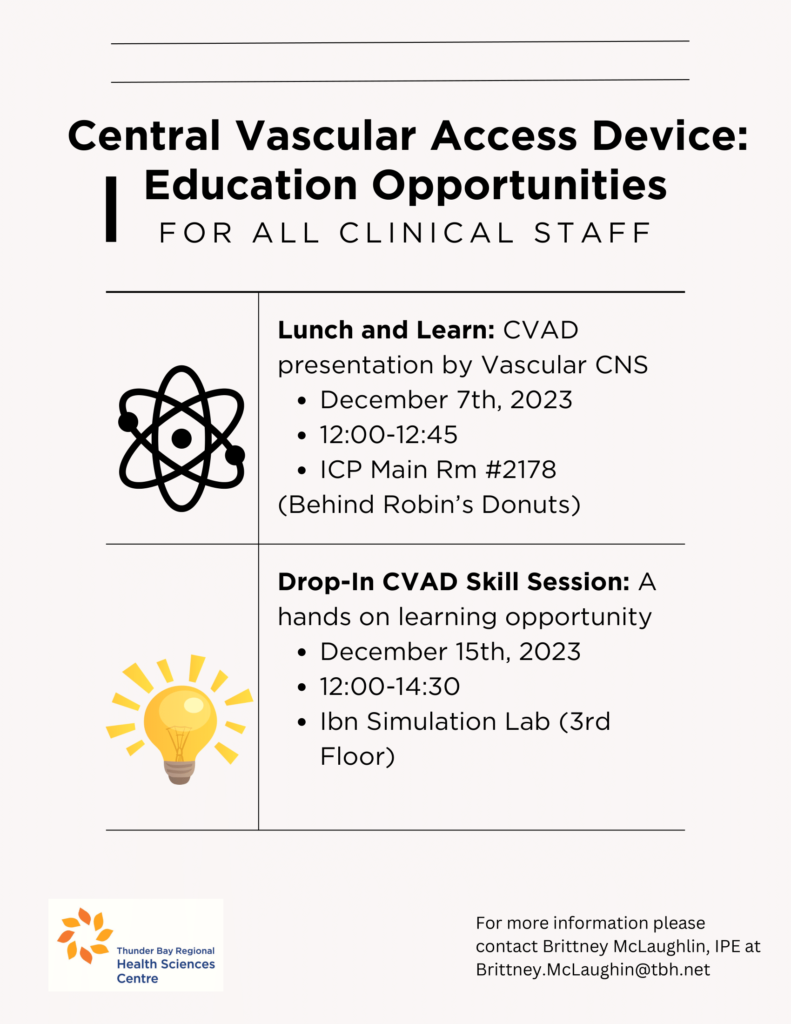
The Clinical Nurse Specialists (CNS), Interprofessional Educators and Nursing Professional Practice Leaders will be facilitating hospital-wide central vascular access device (CVAD) education during the month of December. Below are education opportunities that all clinical staff can join as part of their learning and professional development:
Education Event
Date
Time
Location
Lunch and Learn
December 7, 2023
12:00-12:45
ICP Main, Room 2178
CVAD Skill Session
December 15, 2023
12:00-14:30 (drop in anytime during this time frame)
Ibn Sina Simulation Centre, Room 3100
Roaming Education
Month of December
Intermittent drop ins
All in-patient and out-patient units
Please encourage your staff to participate in these education opportunities!