We’re pleased to inform you that T4 tax slips for the 2024 tax year are now available for viewing and printing through the Employee Self Service (ESS) Portal.
To access your T4 tax slip, simply log into the ESS portal and select the “Tax Slips” option.
A quick reminder: If you plan to access your T4 from home, you must first enroll in Cisco Duo to enable multi-factor authentication. If you haven’t done this yet, please contact the Help Desk at 684-6411 or help@tbh.net for assistance.
Please note that some employees may receive two T4 slips for the same tax year. We kindly ask you to review your tax documents carefully and ensure both slips are included in your income tax preparation, if applicable.
If you have any questions or concerns, please don’t hesitate to reach out to Michael Iorianni, Manager of Payroll & Accounting, at 684-6917 or michael.iorianni@tbh.net.
Every year in Canada, Pink Shirt Day is observed on the last Wednesday in February to take a stand against bullying.
The first Pink Shirt Day took place in 2007. It was inspired by the efforts of two Grade 12 students in Nova Scotia, who distributed pink shirts to all of the boys at their school in a show of solidarity for a grade 9 boy who was bullied for wearing a pink shirt.
Bullying includes behaviours such as physical aggression, verbal abuse, exclusion, or online harassment that are repeated; these behaviours humiliate, intimidate, cause physical and emotion harm, and traumatize the person who is being bullied. Over 75% of people say that they have experienced bullying.
Youth who are bullied experience long-term impacts to their physical and mental health, including stress-related illnesses, low self-esteem, and suicidality (BullyingCanada, 2025).
To learn more about how to support youth who are being bullied, please visit BullyingCanada, here.
To learn more about Pink Shirt Day, please visit The CKNW Kids’ Fund’s Pink Shirt Day website, here.
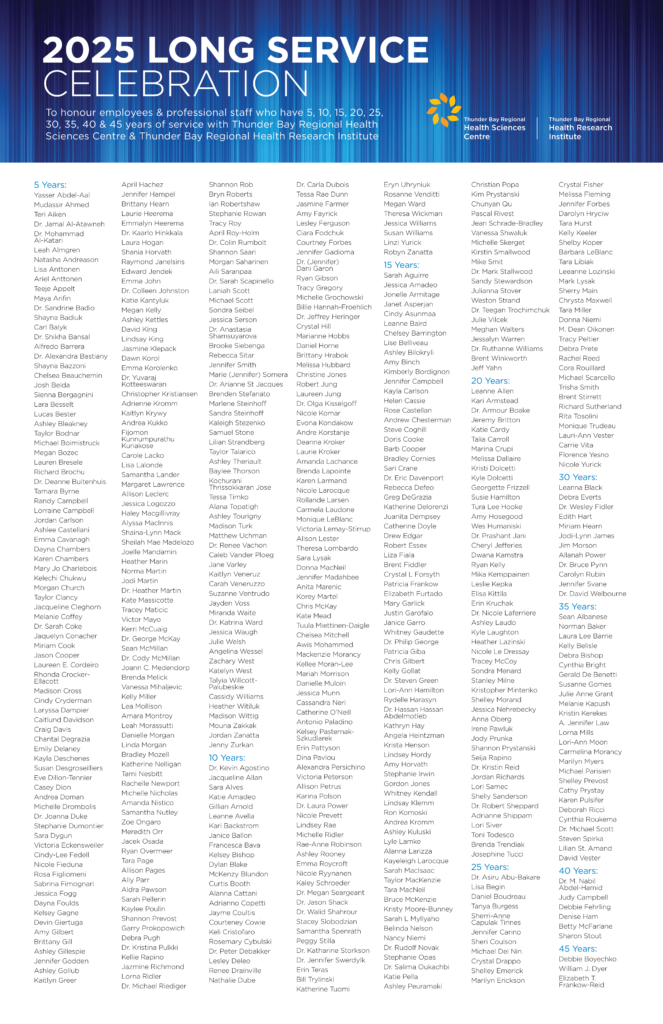
The Long Service Celebration honours employees and professional staff who have 5, 10, 15, 20, 25, 30, 35 and 40 years of service with Thunder Bay Regional Health Sciences Centre and Thunder Bay Regional Health Research Institute.
February is Psychology Month. Psychology is rooted in science that seeks to understand our thoughts, feelings and actions. It is a broad field – some psychology professionals develop and test theories through research while others work to help individuals, organizations, and communities function better. Still others are both researchers and practitioners.
Psychology Month is celebrated every February to highlight the contributions of Canadian psychologists and to show Canadians how psychology works to help people live healthy and happy lives, help their communities flourish, help their employers create better workplaces, and help their governments develop effective policies. Please join us in thanking the Psychologists and Psychological Associates who work at our Hospital and serve our community.
Read this memo and review the updated Code Blue/Pink/NRP (EMER-140) policy to familiarize yourself with important process changes.
Managers to ensure that the updated policy is added to their area’s emergency binder (remove and recycle previous versions of the policy) and that all workers review the attached safety huddle and policy.
Policy changes:
Updated Code Blue and Code Pink definitions to clarify that the Code can be called for those who have “an altered level of consciousness and/or require airway management,” not just those requiring cardiopulmonary resuscitation.
Clarification that any worker can activate a Code Blue/Pink/NRP.
Clarification regarding response for the penthouse, including additional actions taken by Security and the inclusion of both Code Teams.
New Appendix provides a list of the locations for all ward airway boxes.
New Roles and Responsibilities table displays response actions in the same format utilized for other emergency colour code polices.
To activate a Code Blue/Pink/NRP: Dial “55” from a hospital phone and state “Code Blue/Pink/NRP + location + age (Code Pink) + room number (if applicable)”.
Call 911 for any individual who collapses outside of the Hospital; The CAR team may proceed outdoors to provide Basic Life Support while awaiting Emergency Medical Services arrival.
If an individual requiring medical assistance remains alert and able to communicate or otherwise express themselves, e.g., talking, gesturing, crying, a Code Blue should not be called, refer to Alert 99 and Alert 99-Trauma (EMER-120).
If you have any questions, please reach out to Mēsha Richard, Lead, Emergency Preparedness (ext. 6552 or mesha.richard@tbh.net)
In honor of Black History Month, we recognize and celebrate the invaluable contributions of Black Canadians to the health care sector. Their resilience in the face of adversity, including racism and unequal opportunities, has empowered them to break barriers and achieve remarkable milestones. These trailblazers became pioneers in their respective fields, driving significant advancements in healthcare and social justice within their communities, while also paving the way for future generations.
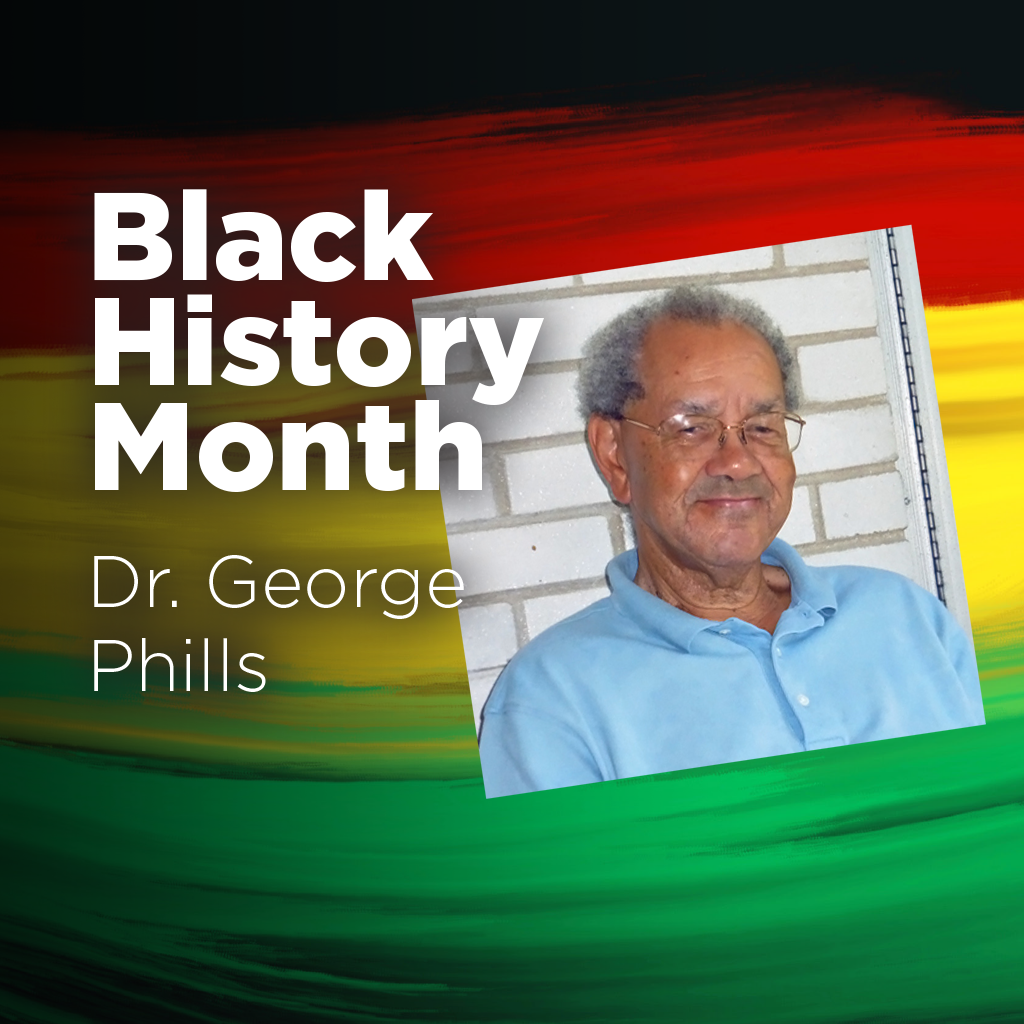
Below, we highlight the biographies of Bernice Redmon and Clotilda Douglas-Yakimchuk, who made notable contributions to nursing; Dr. Sophia Bethena Jones, the first Canadian to earn a medical degree; and Dr. George Phills, a psychologist whose work significantly impacted the well-being of children and families.
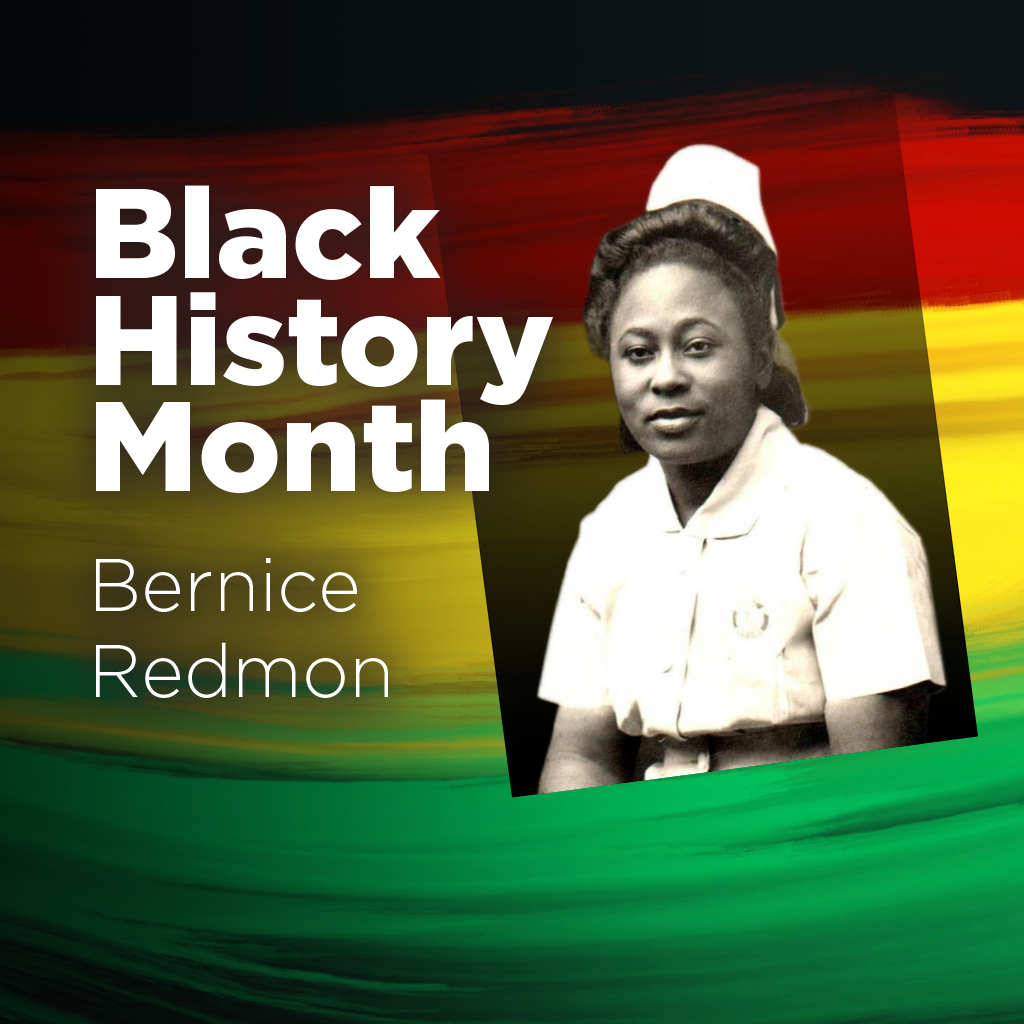
Bernice Redmon
Bernice Redmon (nee Carnegie) was born in Toronto on October 28, 1917. She made history as the first Canadian-born Black registered nurse, and the first Black nurse to be employed by the Victorian Order of Nurses (V.O.N.).
Her nursing journey was not without its challenges, as Canadian nursing schools in the 1940s did not admit Black students. In response, Bernice moved to the United States, where she earned her nursing degree from the St. Philips School of Nursing in Virginia. Demonstrating remarkable academic ability, she excelled in her studies and was awarded a scholarship to pursue an additional year of training, specializing in public health nursing.
Bernice graduated in 1945; she returned to Canada that same year, where she began her career with the Nova Scotia Department of Health, becoming the first Black nurse to practice in public health. Her ground-breaking work in the field opened doors for Black women to work and train in Ontario hospitals starting in the late 1940s and 1950s.
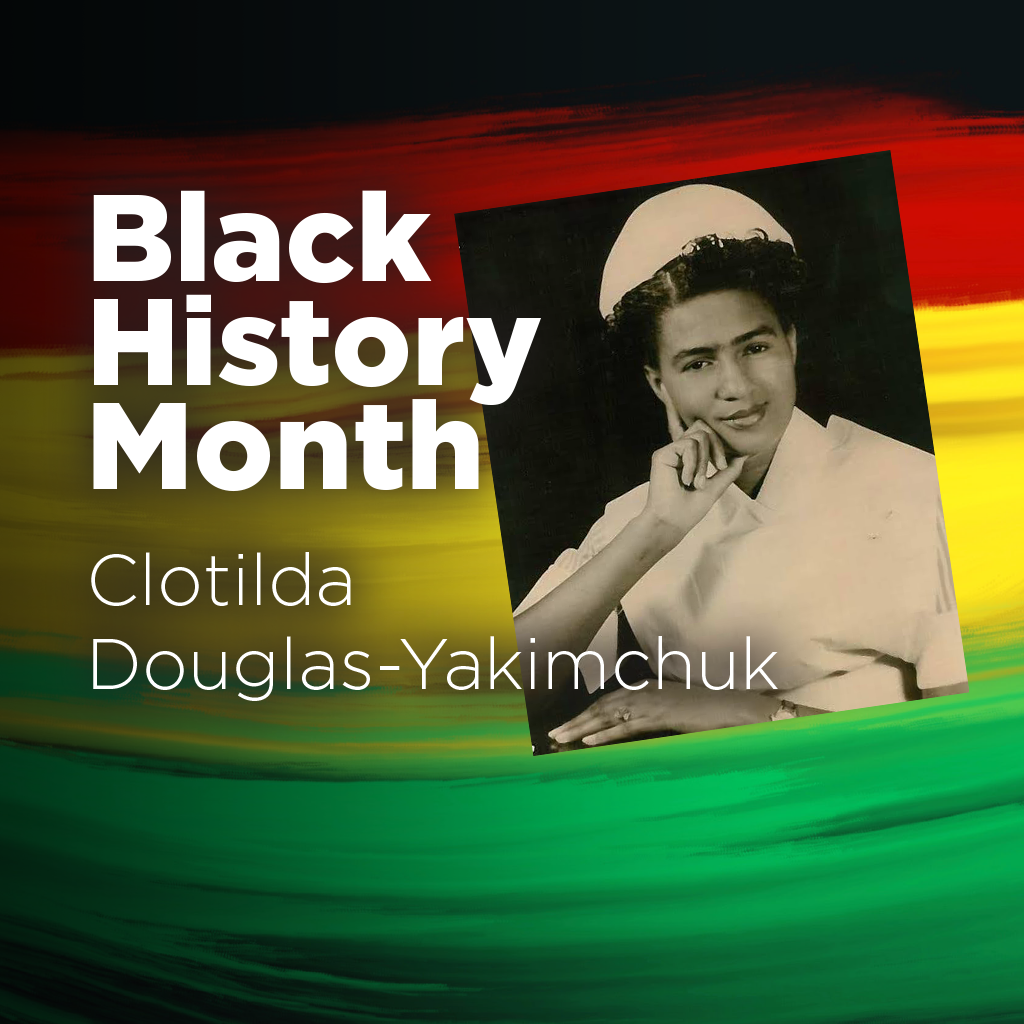
Clotilda Douglas-Yakimchuk was born and raised in Whitney Pier, Nova Scotia. In 1954, she made history as the first Black individual to graduate from the Nova Scotia Hospital School of Nursing. She went on to earn post-graduate diplomas in midwifery from Colony Hospital, Grenada, West Indies; and adult education from St. Francis Xavier University; as well as a post-graduate certificate in psychiatric nursing from the Nova Scotia Hospital.
Throughout her distinguished 50-year career in nursing, Clotilda served in various roles, including as a staff nurse, nursing supervisor, and Director. She also held the esteemed position of President of the Registered Nurses’ Association of Nova Scotia (now The College of Registered Nurses of Nova Scotia), and was the only elected Black President in the college’s 100-year history.
Beyond her nursing career, Clotilda was a passionate community advocate and a proponent of lifelong learning. She was the founding President of the Black Community Development Organization, an organization that championed causes such as affordable housing and improvements to seniors’ living facilities. Clotilda also played a key role in advocating for the establishment of a nursing degree program at Cape Breton University.
Clotilda retired from nursing in 1994. In recognition of her lifetime of activism and exceptional service to her community and the nursing profession, she was appointed to the Order of Canada in 2003, the Order of Nova Scotia in 2018, and received an honorary Doctorate of Laws from Cape Breton University in 2010.
Dr. Sophia Bethena Jones was born in Chatham, Ontario, on May 6, 1857. Her parents were involved in the Canadian abolitionist movement, and their activism was said to have inspired Dr. Jones’ to forge a path for women in the medical field.
In 1879, Dr. Jones began studying Biology at the University of Toronto; however, due to pervasive racism and sexism, she was denied the opportunity to continue her studies at the university’s medical school. Undeterred, she pursued her dream of becoming a physician and was accepted into the University of Michigan Medical School in 1880. In 1885, Dr. Jones made history as the first Black woman to graduate from the school with a medical degree. Dr. Jones also holds the distinction of being the first Black Canadian to earn a medical degree.
Dr. Jones went on to teach medicine at Spelman College in Atlanta, Georgia as the first Black faculty member. She then continued her medical practice across the United States.
Dr. Jones was also a pioneer in medical research, being one of the first Black women to publish in the field. Her influential research, “Fifty Years of Negro Public Health,” was published in the Annals of the American Academy of Political and Social Science in September 1913. In this work, she highlighted the health disparities within Black communities, the long-term effects of intergenerational trauma from slavery, and advocated for equity in healthcare for all.
Dr. George Phills was a distinguished Black psychologist who dedicated his life to serving his community and improving the well-being of children. Born in Sydney, Nova Scotia to Mary Alda Phills and Isaac Phills, Dr. Phills’ parents instilled in him the values of family, community, education, and perseverance from an early age. He pursued higher education at King’s College in Halifax, earned a Master’s in Clinical Psychology from Dalhousie University, and obtained a PhD in Clinical Social Psychology from the University of London in England.
Following the completion of his studies, Dr. Phills returned to Sydney, where he headed a child guidance clinic. He later moved to London, Ontario, where he embarked on a 22-year long career with the London Board of Education—initially as a Consulting Psychologist and later, as Chief Psychologist. Dr. Phills developed several programs throughout his tenure, including the Early Identification Process, the Social Skills Project, and the Tragic Event Response Team. In addition to his professional work, Dr. Phills supported individuals facing family challenges and systemic racism, served on the boards of numerous mental health organizations in London, taught at Western University, and was instrumental in establishing the Ontario College of Psychology.
Dr. Phills’ outstanding contributions to both his profession and his community were recognized through numerous prestigious awards, including the Bea Wicket Award (1990), the Frank Brennan Award (1995), and the Distinctive Service Award from the London and Region Psychological Association (1996). To learn more about Dr. George Phills, please go to: https://www.canada.ca/en/canadian-heritage/campaigns/black-history-month/black-canadians.html#s6
If you have any questions, or would like to provide feedback related to equity, diversity, and inclusion, please contact Rae-Anne Robinson, Equity, Diversity & Inclusion Coordinator at rae-anne.robinson@tbh.net, or the Equity, Diversity, and Inclusion Steering Committee at tbrhsc.edisteeringcommittee@tbh.net.
Afonso Creations’ Pocket Hug Fundraiser is still going! Pocket Hugs are $5, and succulents are $20, with part of the proceeds supporting the Northern Cardiac Fund.
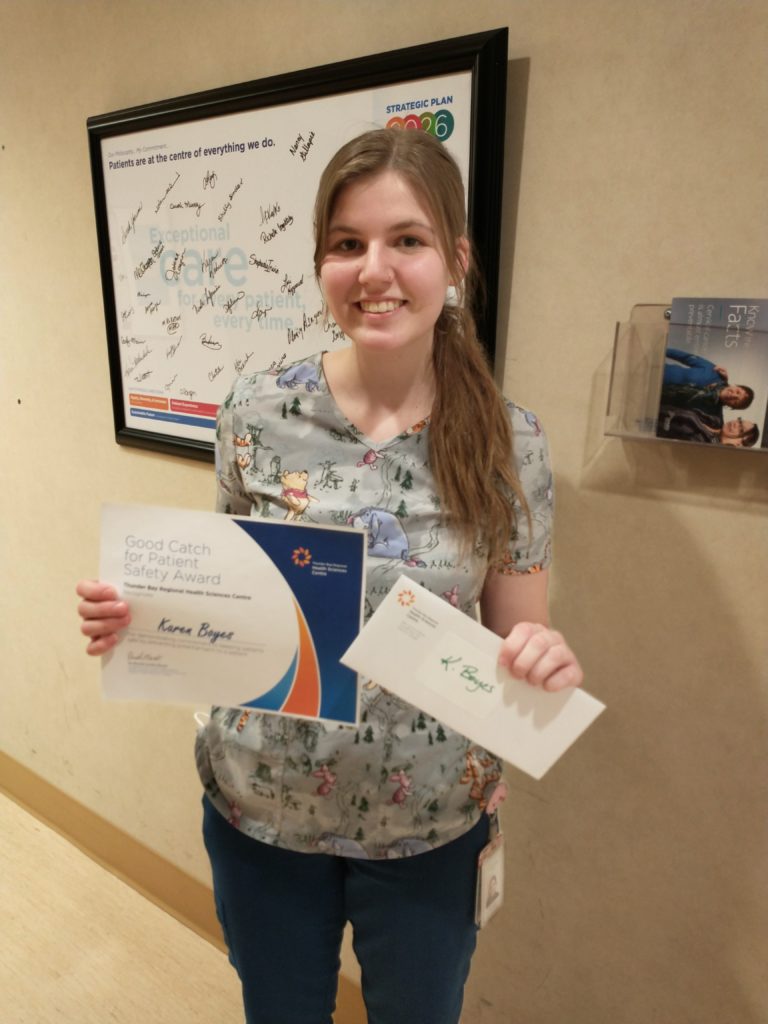
Congratulations to the winners of the quarterly ‘Good Catch’ Awards, Karen Boyes and Chelsea Hurd.
Good Catch Awards highlight individuals, groups or departments who demonstrate their commitment to keeping patients safe by reporting a near miss. A ‘good catch’ (or near miss) is an event or situation that could have resulted in harm, but did not reach the patient because of chance or timely intervention. Reporting these events can help to identify gaps in order to prevent future adverse events from happening.
Karen was working in the Cancer Centre when she received a dose of carboplatin at the Pharmacy with an incorrect label. The dose was not within 10% of the calculated dose and would, therefore, be unsafe to administer. An independent double-check was completed with another nurse. Karen then called the pharmacist to request that the chemotherapy be remixed to ensure proper dosing and labelling. Great catch!
Karen Boyes
While working on 2C, day nurse Chelsea followed a physician’s orders to discontinue oxygen and discharge a patient home. However, it was noted that the patient still required oxygen. Chelsea completed a walking test without oxygen, and the patient continued to desaturate, after which she notified the physician. This led to the discharge being put on hold until RT could re-assess. It was determined that the patient qualified for home oxygen. Chelsea used great nursing judgment in advocating for a delayed discharge. Good initiative!
Thank you to both for your diligence and dedication to safety! Each recipient has been awarded a certificate and gift cards to local businesses.
New winners will be selected every quarter. Continue submitting your near misses for a chance to win! Near miss reports are submitted through the Incident Learning System (patient safety incidents). Click on the ‘safety reporting’ icon from your Novell home page, or go to the iNtranet and choose ‘Safety Reporting’ under ‘Informational’.
For more information, contact Terry Fodë, Patient Safety Improvement Specialist (terry.fode@tbh.net).
Shared on behalf of Jeannine Verdenik, Vice President People and Culture
As part of our ongoing commitment to safety, we are pleased to announce the distribution of new safety lanyards that adhere to the latest safety standards. These lanyards feature a 3-way breakaway mechanism, which is essential for ensuring safety.
Key Points:
1. Distribution of New Lanyards:
New lanyards will be provided to Leadership for distribution to all staff, volunteers, and learners based on their primary department, during the week of February 24, 2025.
Going forward, lanyards will be distributed during general orientation/on-boarding by the responsible department:
Human Resources: Employees (TBRHSC and TBRHRI)
Patient and Family Centered Care: Volunteers and Patient and Family Advisors
Academics: Learners, Medical Students and Residents
Medical Affairs: Professional Staff
2. Discontinuation of Retractable Reels:
Effective immediately, we will discontinue the use of all retractable reels. These may pose a safety risks and therefore do comply with our new standards.
3. Removal of Non-Compliant Lanyards:
Additionally, all lanyards that do not meet the 3-way breakaway safety standard must be removed from use.
We will update our dress code and related policies and identify procedures for replacement of lost or damaged lanyards to ensure an accessible and efficient method for all team members.
We appreciate your cooperation in this important matter. Ensuring a safe working environment is a shared responsibility, and your adherence to these new standards is crucial.
If you have any questions or concerns, please feel free to contact Human Resources or Occupational Health and Safety.
This month’s Town Hall took place on Wednesday, February 19 at 2:00 p.m. See below for a video recording of the session and a copy of the presentation slides.
If you have questions you would like answered, please send them to TBRHSC.GroupNews@tbh.net and we will do our best to address them at a future Town Hall.
If you’d like to access a recording or presentation from a previous Town Hall, visit the archive.
Thank you for your commitment to staying informed and engaged.