Regional Indigenous Knowledge Gathering Event (March 18-19)



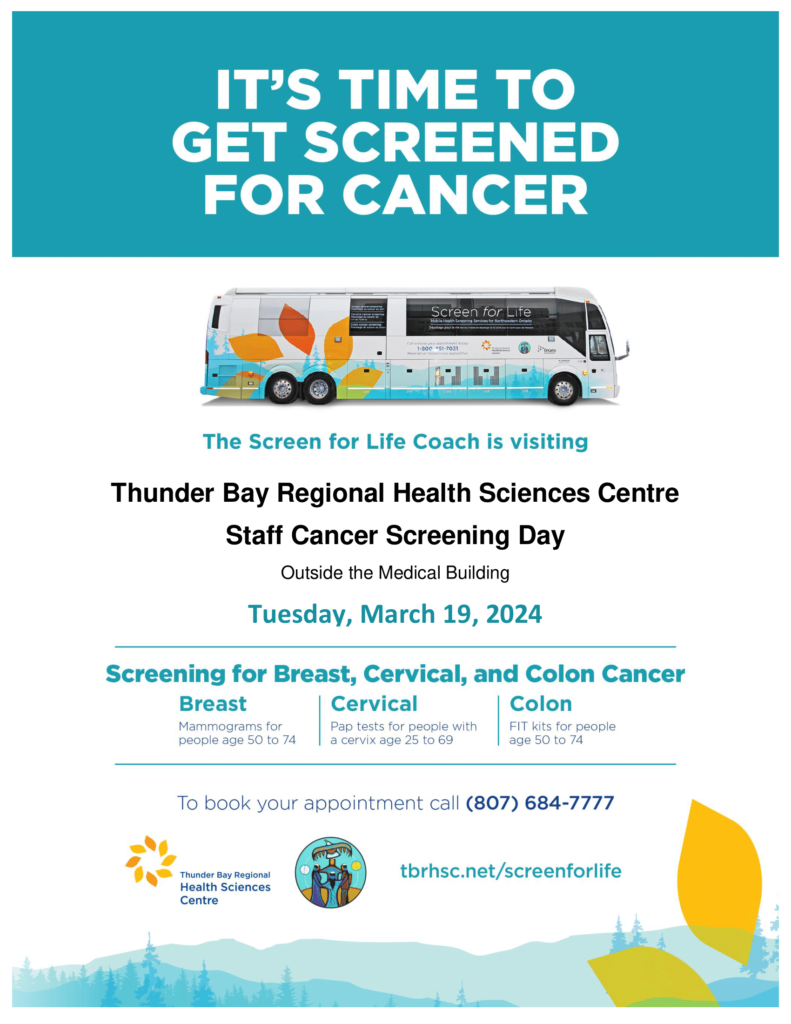
On March 19, the Screen for Life Coach will be parked at our Hospital to provide cancer screening services to our staff, professional staff, learners and volunteers.
The Coach offers:
Breast screening: Most women, Two-Spirit, trans and nonbinary people, ages 50 to 74 years, should have mammogram every two years.
Cervical screening: Anyone with a cervix aged 25 to 69, who has ever been sexually active, should complete a Pap test every three years.
Colon screening: People aged 50 to 74 with no first-degree family history of colon cancer should complete a fecal immunochemical test (FIT) every two years.
Services can be accessed without a referral and are available even if you have a primary care provider.
If you’re due for breast, cervical or colon cancer screening, call (807) 684-7777 to book your appointment.

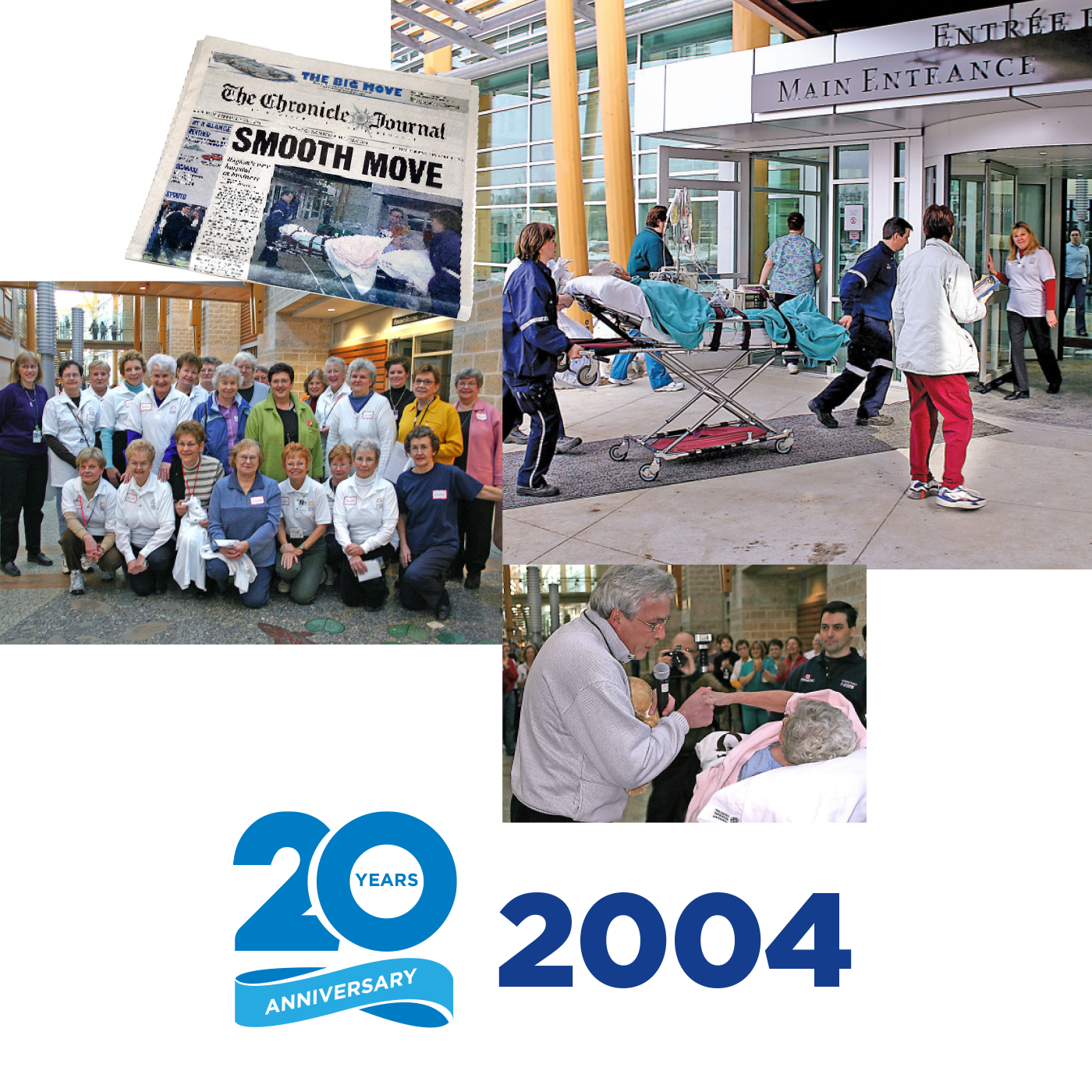
The Health Sciences Centre held an event for staff last week to celebrate the building’s anniversary.
Last Thursday the Thunder Bay Regional Health Sciences Centre celebrated 20 years since the opening of its building on Oliver Road.
The health sciences centre opened the doors at its current location on Feb. 22, 2004, and it has grown steadily since then.
Hospital president and CEO Rhonda Crocker Ellacott said she vividly remembers opening day.
“When we think back to the last 20 years in this building, so many things have changed,” she said.
The hospital held a celebratory event for staff last week that Crocker Ellacott said helped staff recognize their contributions towards the hospital.
“There’s been so many different things that we’ve done in every aspect of the organization, so we took last week to have a little bit of a walk down memory lane and really celebrate with our staff the amazing things that have happened. We celebrated the growth of the organization and how we’ve really come to adapt to reflect the needs of our patients across Northwestern Ontario,” she said.
Crocker Ellacot said even with all of the growth the hospital as a whole has seen, what she’s most proud of is the innovations, contributions, dedication and commitment shown by hospital staff throughout the years.
“Honestly, I think there’s areas to be proud of in each and every program and service of the organization. So, I can go back and talk about the advancements in surgery,” she said.
Crocker Ellacot said there’s plenty to celebrate — “whether it be the programs that we put in place to help patients connect better with their surgeons and with their care team around Seamless MD, in cardiac, around our new cath lab and around being able to provide angioplasty, in renal and introducing home hemodialysis or in the service areas.”

The Ladies of The Italian Society of Port Arthur are hosting their annual Spring Tea in support of the Northern Cancer Fund on Sunday, April 21, 2024.
Dress to impress and join us at the Italian Cultural Centre at 132 South Algoma Street for afternoon tea featuring a bake sale, door prize, and a penny auction!
Tickets are $10 each and available for purchase at the Health Sciences Foundation Donation Office beside Robin’s Donuts, or available at the door on event day.

We’re celebrating 20 years of Thunder Bay Regional Health Sciences Centre (TBRHSC). Throughout the year, we’ll be taking a trip down memory lane to revisit some of our most significant milestones.
Thank you to our dedicated staff, donors to the Thunder Bay Regional Health Sciences Foundation, community members and partners in health who have played a vital role in building exceptional healthcare for patients and families in Northwestern Ontario.
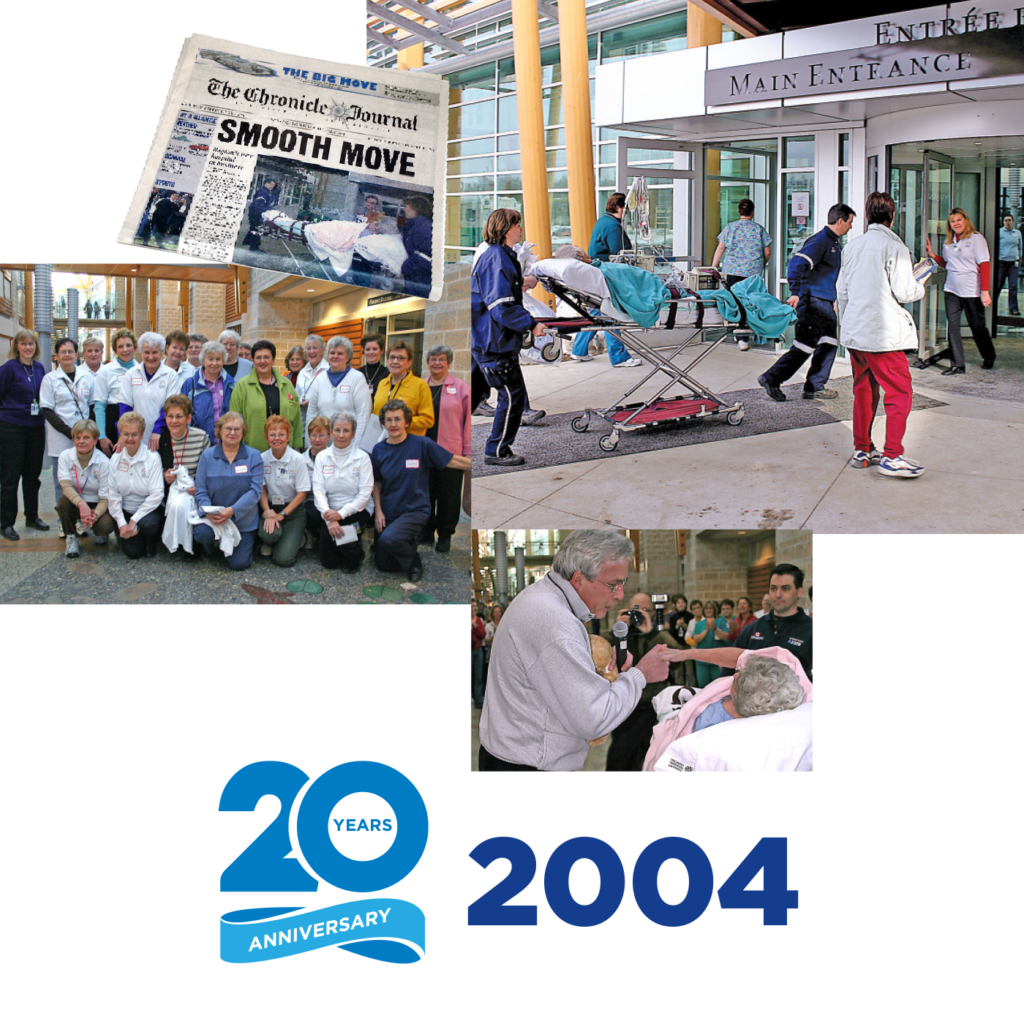
📅 𝟮𝟬𝟬𝟰 (📸 1): On February 22, 2004, Thunder Bay Regional Health Sciences Centre welcomed its first patients.
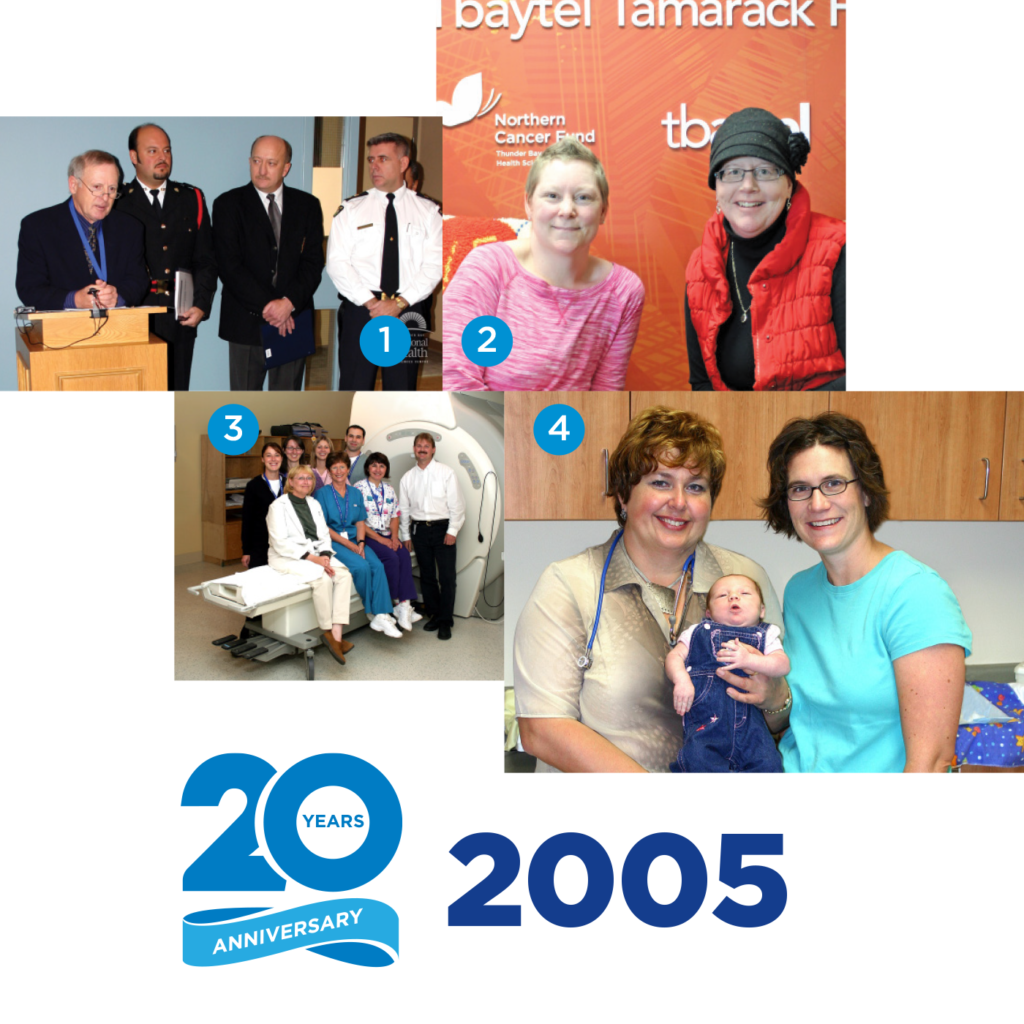
📅 𝟮𝟬𝟬𝟱 (📸 2):
1) The Sexual Assault/Domestic Violence Treatment Centre opened to serve victims and survivors of sexual assault and/or domestic violence.
2) Tbaytel Tamarack House opened, a “home away from home” for regional cancer patients.
3) A second MRI (Magnetic Resonance Imaging) was installed, more than doubling TBRHSC’s capacity and reducing patient waiting time.
4) The Maternity Centre opened to offer services from a team of care providers to help mother and baby stay healthy.
Visit www.tbrhsc.net/20years for more milestones.

Pink Shirt Day (February 28) celebrates kindness and take action against bullying. Remember, a small act of kindness can go a long way. Whether you reach out to someone who is struggling or call out bullying behavior when you see it, we can all make a positive difference in the lives of those around us. #YouAreNotAlone, so never hesitate to ask for help if you need it. Let’s work together to create a world free of bullying, one kind act at a time!
Pink Shirt Day began in 2007, after David Shepherd and Travis Price wanted students at their school to wear pink to stand with a Grade 9 boy who was bullied for wearing a pink shirt.


We would like to inform you that T4 tax slips for the 2023 tax year are now accessible for viewing and printing through the ESS (Employee Self Service) Portal.
To access your T4 tax slip, please log into your ESS portal and select the “Tax Slips” option.
If you wish to access your T4 from home, you must first enroll in Cisco Duo to enable multi-factor authentication. If you haven’t done so already, please contact the Help Desk at 684-6411 or help@tbh.net.
Important Reminder: Please be aware that certain employees will receive two T4 slips for the same tax year. Kindly review them carefully to determine if you have been issued two T4 slips, as both will be required for income tax preparation.
Should you have any questions or concerns, feel free to contact Michael Iorianni, Manager of Payroll & Accounting, by phone at 684-6917 or via email at Michael.Iorianni@tbh.net.

Shared on behalf of Alex Sieswerda, Chief of Midwifery, TBRHSC
Thunder Bay Regional Health Sciences Centre and the Midwifery Department want to thank Sandra Shymko for her long-time service to our community and congratulate her on her retirement.
Sandra is a registered midwife who has been providing primary care to families in Thunder Bay and region since 2002.
Sandra – your knowledge, experience and integrity will be truly missed. Enjoy skiing, biking and travelling! All the best in your future adventures.
Sandra’s last day will be February 29, 2024.

Do you want to recruit, integrate and/or retain Internationally Educated Nurses (IENs)?
This requires commitment to increase workforce diversity and provide culturally competent care.
CARE Centre for Internationally Educated Nurses is offering FREE virtual lunch and learn sessions to all TBRHSC and SJCG employees.
If you’re an IEN, or work with IENs, we encourage you to attend the Workplace Diversity and/or Empowering IENs to Succeed sessions.
March 5 & 19, 2024 from 12:00 p.m. – 1:00 p.m.
Learn how to facilitate a smooth transition and successful integration of IENs into the workforce. This session offers strategies to make this process as open and equitable as possible. Everyone from boardroom to bedside is encouraged to attend. Whether you are human resources, leadership, management, nursing or any member of the healthcare team, you do not want to miss out on this learning opportunity.
March 14 & 21, 2024 from 12:00 p.m. – 1:00 p.m.
This session will provide practical knowledge/skills/strategies to support safe, ethical and legal nursing care in Ontario. It includes topics such as interprofessional collaboration and client/patient and family centered care.
Register Today by clicking the link below:
https://thunderbayhospitals.webex.com/webappng/sites/thunderbayhospitals/webinar/webinarSeries/register/21a08cbea7ea46b88b88be555b8d7755
Originally published by NOSM University
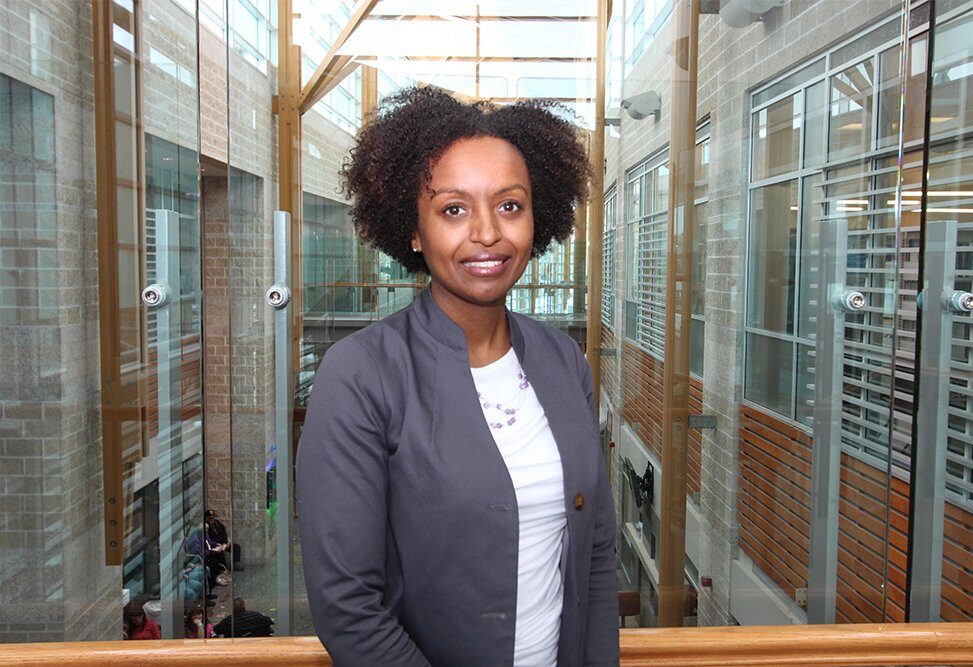
Dr. Naana Jumah, an Obstetrician Gynaecologist at Thunder Bay Regional Health Sciences Centre and Assistant Professor at NOSM University, is an ally and advocate for Indigenous maternal health, and the recent winner of the Society of Obstetricians and Gynecologists of Canada’s Carl Nimrod Educator Award. A Rhodes Scholar, PhD in Engineering and Harvard-trained physician, Dr. Jumah has chosen to return home to practise in Thunder Bay, where she grew up after immigrating from Ghana as a child.
She’s quick to credit the many role models who have inspired her—starting with Moffat Makuto, organizer of the Regional Multicultural Youth Center in Thunder Bay.
“Being a newcomer to Canada, I was part of that youth group when I was a kid,” she recalls. “We travelled around the region and did programming for high school students throughout Northwestern Ontario and on reserves. As immigrant and refugee kids, we saw that the kids who had the hardest time adjusting to life in so-called ‘Canada’ were the kids coming from reserves. I saw that then, and it stuck with me. It was an area where I wanted to continue working and have a meaningful impact.”
Dr. Jumah first trained as an engineer, earning a PhD from the University of Oxford on a Rhodes Scholarship. “I loved engineering, but I really missed the kind of interactions I had when I was working with Moffat in the youth group, getting to know people and being part of their lives,” she says. “I applied to medicine hoping to do both.”
She didn’t initially intend to pursue obstetrics and gynecology. But, when a close family member passed away, Dr. Jumah had to rearrange her medical school clerkships. The result was a long clerkship in obstetrics, gynecology, and gynecological oncology, and she fell in love. “I realized that obstetrics and gynecology brought together all my interests. There was a combination of clinics and work in the operating room. There was an option for advocacy; the issues were important. The combination of skills was a really good fit,” she says.
Dr. Jumah has become a strong advocate and ally. She has supported numerous initiatives to help improve maternal health for Indigenous peoples, including working with Confederation College to train Indigenous women as lay maternal infant support workers, and creating a curriculum to train health-care workers in delivering culturally safe care that builds communications and trust with patients.
The work of which Dr. Jumah is proudest is supporting her colleague, Lisa Bishop, to develop an Indigenous midwifery program in Thunder Bay under an alternative funding model for Indigenous midwifery from the Ministry of Health. She supported the funding application for the program and helps in hospital if a patient needs care from an obstetrician.
“It’s been amazing to see the practice grow,” she says. “I’ve played a small part in trying to be an effective ally. I think it speaks to something tangible that we can do as health-care providers in trying to work towards reconciliation. It’s the right thing to do for patients, and it works towards the Truth and Reconciliation Commission’s calls to action—more Indigenous care providers, providing care in a culturally appropriate way.”
“Because of who I am, as a Black physician and immigrant, the challenges that patients face can be more obvious to me than they might be to physicians who have a different background,” she says.
For Dr. Jumah, Black History Month is a time to recognize the breadth of contributions from Black Canadians who have been here for generations, as well as immigrants from the Caribbean and Africa.
“Black History Month recognizes the importance of Black Canadians to the wider country. I think oftentimes the contributions are noticed in sports, arts, and entertainment. Outside of that, contributions are often overlooked, and that’s a stereotype of who Black people are. We’re good at sports, we’re good at music, but we’re not good at other things—like academic or technical accomplishments. Black History Month allows the spotlight to be shone on the community as a whole. That goes a long way into breaking those barriers and eliminating those stereotypes,” she says.