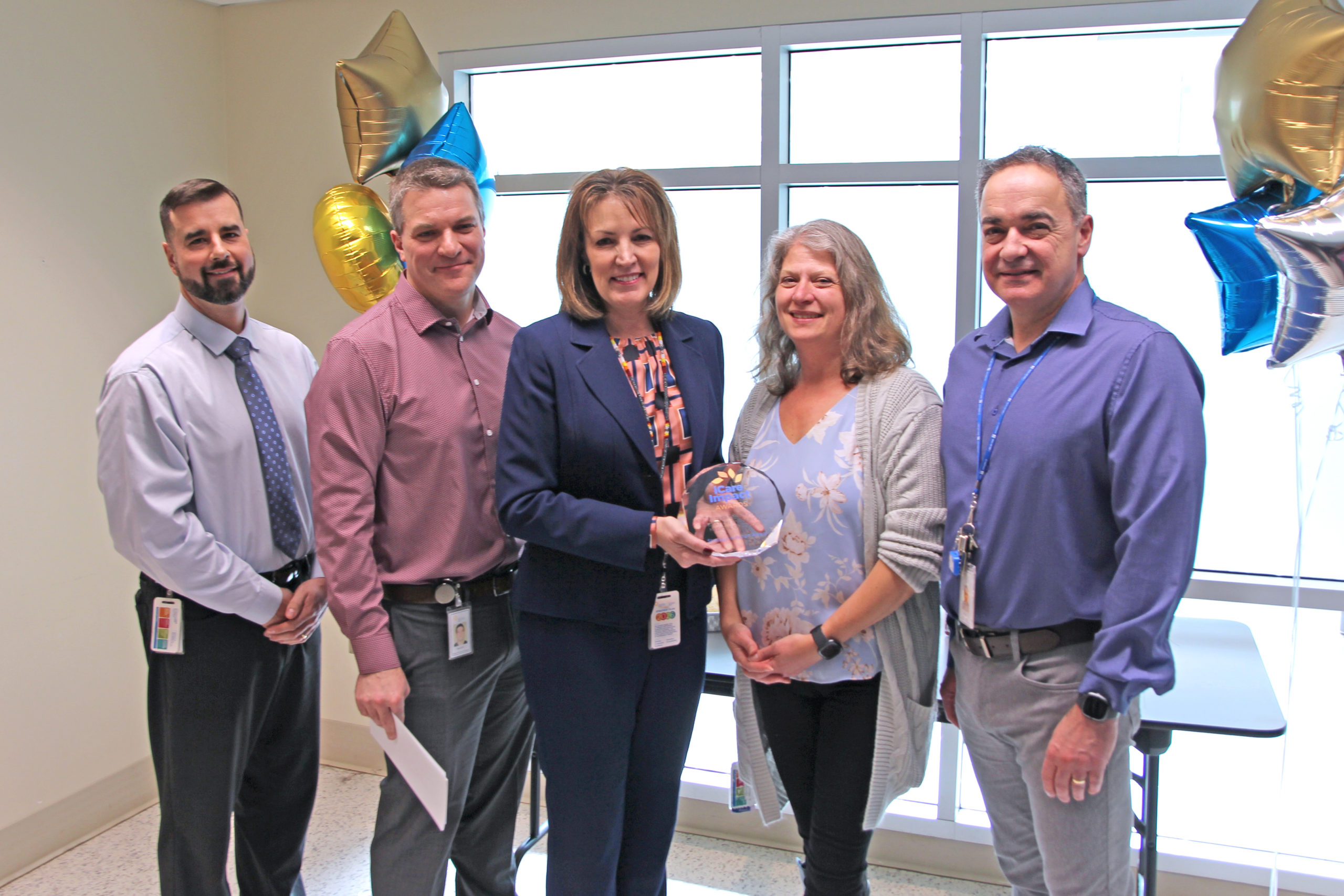
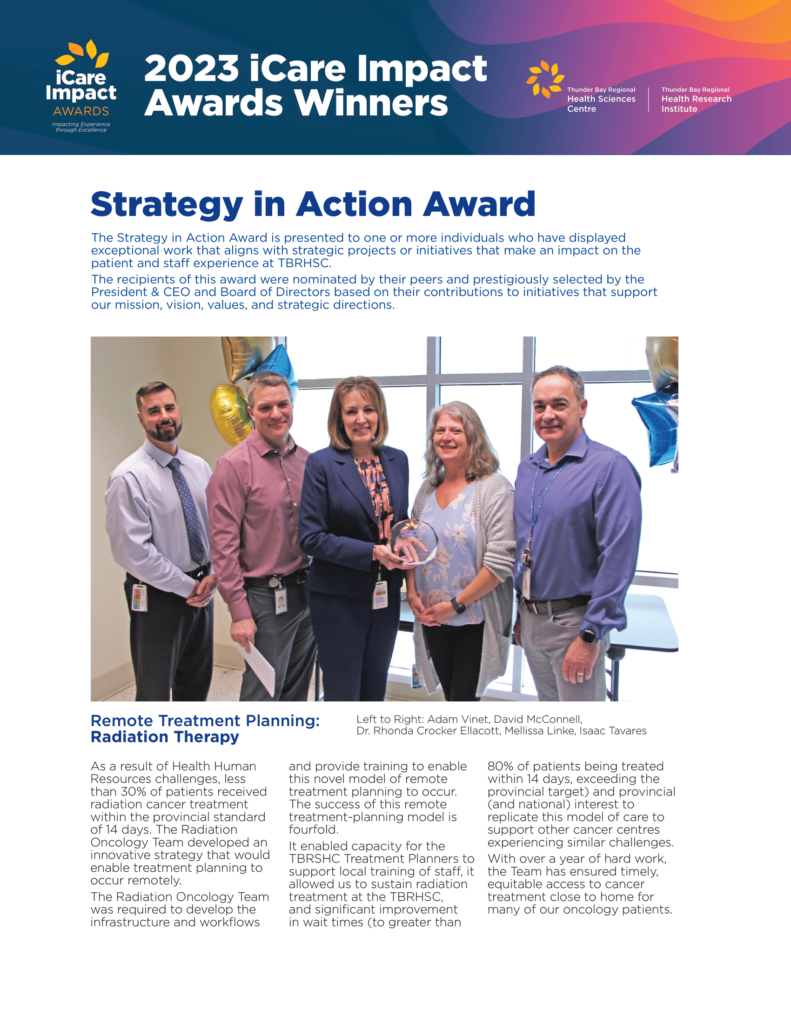
The iCare Impact Awards program is open to all employees, professional staff, Patient Family Advisors, and volunteers of Thunder Bay Regional Health Sciences Centre and Thunder Bay Regional Health Research Institute. It provides a forum for peer-to-peer recognition of positive impacts on our patients and their families.
Nominate now for 2024 to recognize a peer and for a chance to win exciting monthly participation prizes! https://icare-awards.tbrhsc.net/.
Each year, living donor transplants save the lives of hundreds of Canadians awaiting a liver or kidney transplant. Living organ donation offers a shorter pathway to better health with a less wait time and better health outcomes than a deceased donor transplant. Yet many Canadians are not aware of living organ donation.
Living Donation Week (September 8-14) is a national awareness week focused on improving access and equity in living organ donation. This Week invites the living donor and transplant community to come together, celebrate and spread the word about this life-changing gift, and everyone who makes it possible. Launched by the Centre for Living Organ Donation at UHN in 2020, Living Donation Week is now celebrated annually across Canada and beyond, starting the Sunday after Labour Day.
To learn more about living kidney donation in Northwestern Ontario, contact Stacy Heerema, Access to Living Kidney Transplant/Donor Coordinator for Thunder Bay Regional Health Sciences Centre at 807-684-6164.
World Patient Safety Day is an opportunity to raise awareness and foster collaboration between patients, health workers, policymakers and health care leaders to improve patient safety. Each year, a new theme is selected to highlight a priority patient safety area needing urgent and concerted action. This year the theme is Improving diagnosis for patient safety with the slogan Get it right, make it safer!, which highlights the critical importance of correct and timely diagnosis in ensuring patient safety and improving health outcomes.
Diagnostic safety can be significantly improved by addressing the systems-based issues and cognitive factors that can lead to diagnostic errors. Systemic factors are organizational vulnerabilities that are likely to lead to diagnostic errors, including communication failures between health workers or health workers and patients, heavy workloads, and ineffective teamwork. Cognitive factors involve clinician training and experience as well as predisposition to biases, fatigue and stress.
On Tuesday, September 17, 2024, the Health Standards Organization (HSO) and Accreditation Canada join the global community in celebrating World Patient Safety Day with a special virtual event focused on improving diagnosis for patient safety. Quality & Risk Management encourage you to be a part of this crucial conversation driving the future of patient safety. Register now to secure your spot in this web event. Key topics include:
Navigating Diagnostics: Strategies and solutions to enhance diagnostic accuracy and patient safety outcomes.
Care Transitions: Best practices and research for managing integrated care transitions to ensure continuity of patient care.
Future of Diagnostics: Advances to health care that benefit patient care, including improved diagnoses and treatments.
If you are interested in attending but need somewhere to watch the event, please reach out to the Patient Safety Improvement Specialist, Terry Fodë, to arrange your attendance by emailing terry.fode@tbh.net or calling extension 6754 no later than Thursday, September 12 to sign up.
Shared on behalf of Infection Prevention and Control
Please be advised that the COVID-19 outbreak has been declared over on 2A medical unit at Thunder Bay Regional Health Sciences Center as of Friday September 06, 2024. All restrictions have been lifted and regular activities to resume tomorrow, Saturday September 07, 2024.
Please share this information with the appropriate staff.
For more information, contact Infection Prevention and Control at 807-684-6094.
Join Donna Berta RN, BScN, Clinical Project Coordinator – Nursing, ORBCoN, as part of the “Transfusionists Talk” webinar series to learn about Intravenous Immune Globulin (IVIG).
Two Sessions: September 18, 2024 from 9:30 a.m. to 10:10 a.m. (EST). Click here to register; and 2:30 p.m. to 3:10 p.m. (EST). Click here to register.
Learning Objectives:
To apply the responses to transfusionist IVIG questions to their practice.
To recognize and understand the clinical indications for IVIG treatment.
To define nursing actions to safety administer IVIG.
Attend this free, virtual, interactive opportunity for learning. Registration is mandatory.
Register for both sessions if unsure of your preferred time. Immediately, you will receive an email from Zoom. This email confirms registration and includes the link to attend that session on September 18, 2024.
If you have any questions, please reach out to Janet Sharun, Coordinator, Transfusion Services at extension 6901 or janet.sharun@tbh.net.
Family CARE Grant Brings Ingenious Homegrown Solution to Life
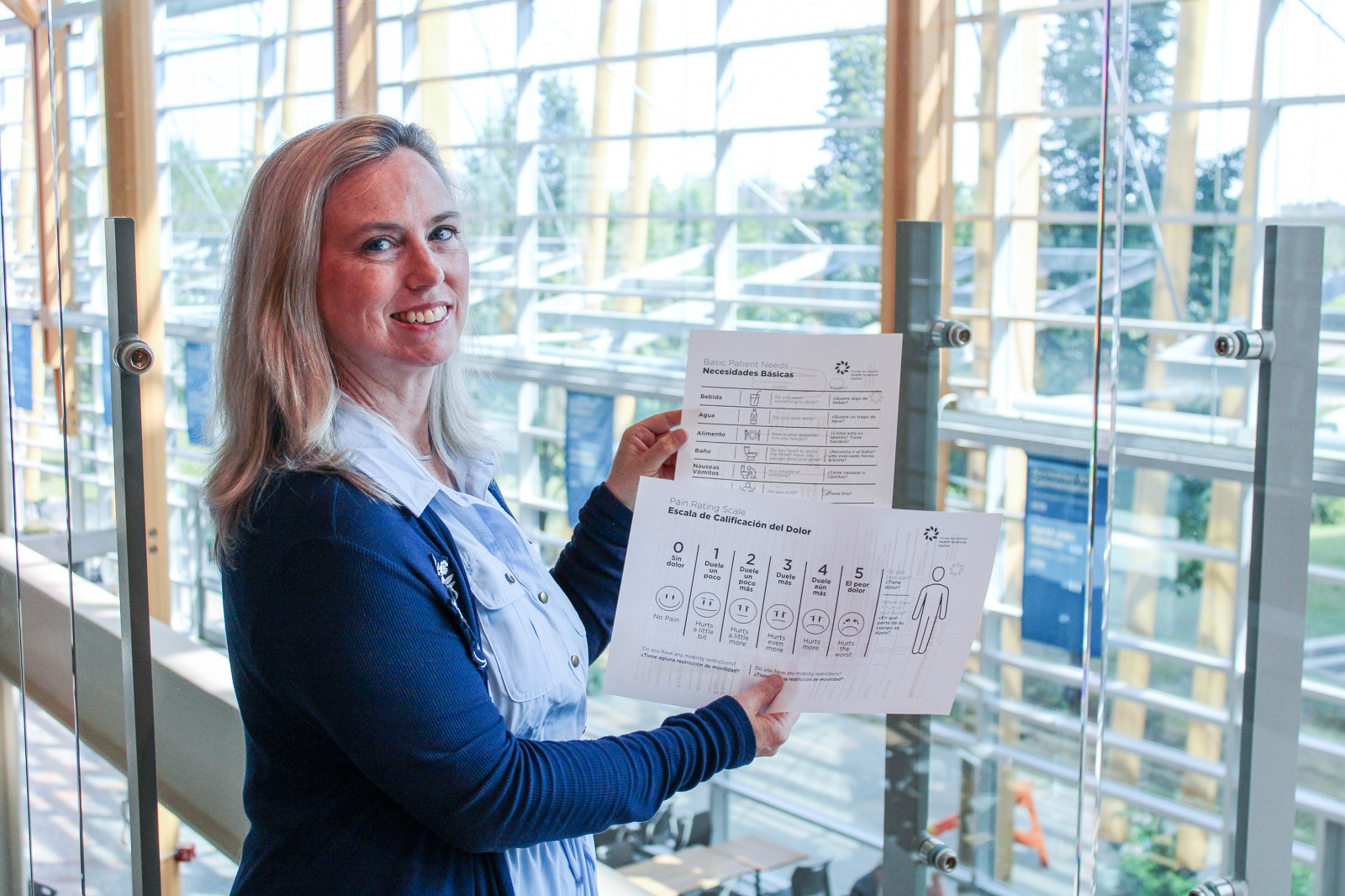
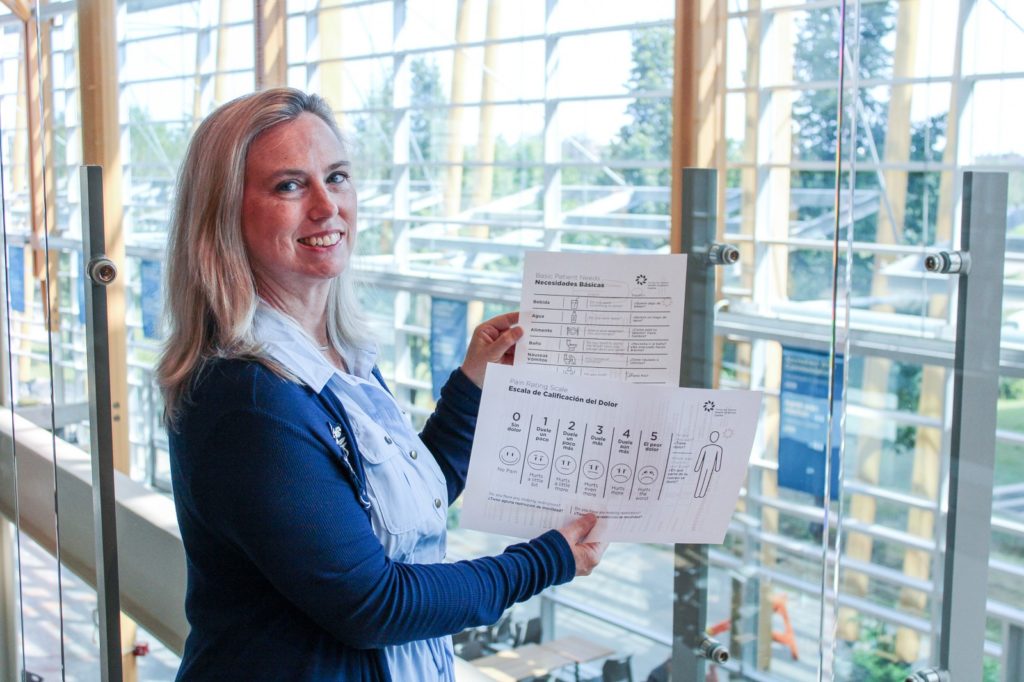
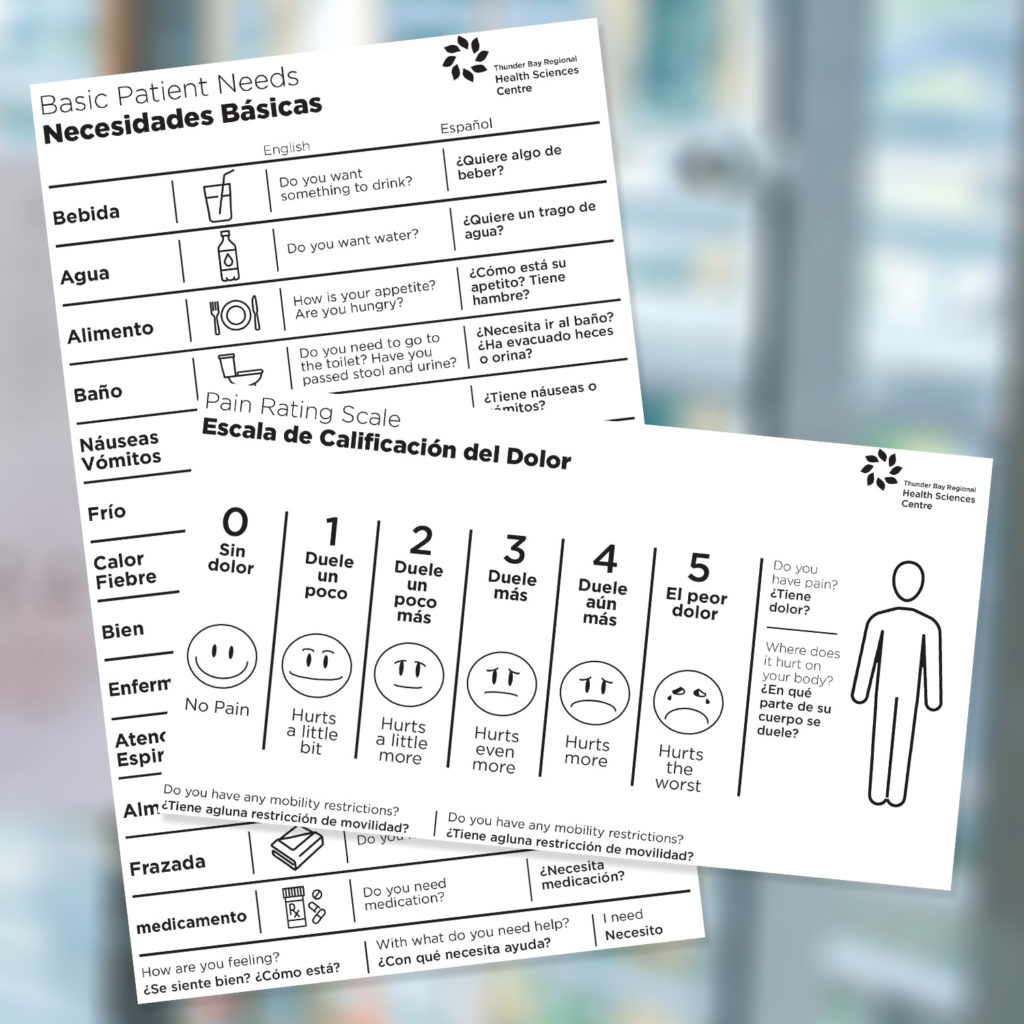
Terry Fodë, Patient Safety Improvement Specialist, Quality and Risk Management presents a mock-up of the Spanish-language Care Communication Card.
Communication plays a huge role in patient care – and it’s a role we often take for granted. For example, think about your own visits to the Emergency Department. The first thing you do is tell the nurse what the problem is. However, even basic questions such as “Where does it hurt?” and “Did you hit your head?” can easily get lost in translation if patient and healthcare professional speak different languages.
Thanks to an ingenious homegrown idea and a Family CARE Grant to support it, our Hospital will soon have a way to communicate the basics quickly and effectively with patients in different languages.
So far in 2024, there have been 101 documented calls for 32 languages at Thunder Bay Regional Health Sciences Centre that required outsourced interpretation services. Fortunately our Hospital is able to access medical interpreters by video or audio 24/7 in 140 languages for interpretation services however there are times when an instant answer to a simple question is needed, and this is when the new Communication Cards will be helpful.
Terry Fodë, Patient Safety Improvement Specialist in the Quality & Risk Management Department, said providing culturally appropriate care is equivalent to safe care, and being able to communicate the needs of a patient can help provide better care.
“Sometimes all you need are a few words to convey a message,” Fodë said.
Fodë, who is also a linguistics specialist, proposed Care Communication Cards to communicate immediate basic needs. The cards would help healthcare professionals at our Hospital understand where it hurts, how much it hurts, whether there is vomiting, and so on. Patients could also communicate their needs such as bathroom, food, water, and pillow. It’s sort of a “communication First Aid” to help patients sooner while the team is waiting for interpretation services to connect.
The cards are modelled after Ojibway tools that the Cancer Centre’s Indigenous Patient Navigator designed. Fodë plans to create a series of laminated cards for several different languages including French, Italian, Finnish, Spanish, Arabic, Farsi, Mandarin, and Hindi. A separate card for non-verbal patients will use pictograms provided by the Aphasia Institute. Clinical Staff and the Patient Family Advisor Council provided feedback to ensure the Care Communication Cards make sense from both clinical and patient perspectives.
Fodë will use a Family CARE Grant to translate, print and laminate those cards, making them easy to disinfect and reuse.
“Initially we will provide Care Communication Cards of the most common languages required as identified by staff, and create a digital library,” Fodë said. “Additionally, I’m creating cards with the English word and the pictogram, but including a blank space. If there’s a language we don’t have available and an essential care partner can provide us with the translation, we can then add it to our library.”
What makes this solution particularly effective is that it is low-tech. Translation apps rely on Internet connections and third-party companies, both of which can be finicky. Besides, Fodë said, those high-tech translations aren’t always accurate.
“Language can be so nuanced,” Fodë said. “The Care Communication Cards keeps it simple.”
The Thunder Bay Regional Health Sciences Foundation’s Family CARE Grant provides funding for frontline employees to fund their own ideas for patient care improvements. In fact, “CARE” stands for “Care Advancements Recommended by Employees.” These grants are funded by donors like you who understand that little things can make a big difference to patient care.
Shared on behalf of Dr. Miranda Lesperance, Vice President, Indigenous Collaboration, Equity &Inclusion
I am pleased to announce Leona Kakepetum as our new Director, Indigenous Collaboration, Equity & Inclusion, effective September 9, 2024.
Leona was previously the interim Manager of ICEI over the past year. She holds a degree in Political Science from Lakehead University and brings leadership experience working as the Interim Health Director at Keewaytinook Okimakanak (KO), a non-political Chiefs Council that serves Deer Lake, Fort Severn, Keewaywin, McDowell Lake, North Spirit Lake, and Poplar Hill First Nations.
Prior to her time at Keewaytinook Okimakanak, Leona worked on the Health Transformation Team at Nishnawbe Aski Nation (NAN), which represents 49 First Nations communities in Northern Ontario. Outside of her formal roles and education, Leona is very committed to community volunteer work. She is a Transplant Ambassador, and an advocate for health.
As the Director for ICEI, Leona will report to the Vice President of Indigenous Collaboration, Equity and Inclusion where she will work directly with the TBRHSC Indigenous Health Hub to improve health delivery and equity outcomes for Indigenous Peoples across the organization. She will also work to advance Equity, Diversity, & Inclusion (EDI) initiatives for other equity-deserving groups that access services at TBRHSC.
Leona will remain on Level 1, Room 1480, Office 1472. She can also be reached via email leona.kakepetum@tbh.net and by phone at 684-7922 or 629-4514.
Please join me in congratulating Leona on her new role within the organization.