History of Pride in Canada
On May 14, 1969, Canada decriminalized homosexuality, following the introduction of Bill C-150 by then Prime Minister Pierre Elliott Trudeau. The bill received royal assent the day before the Stonewall Uprising began in New York City, on June 27, 1969.
The Stonewall Uprising was a significant turning point for 2SLGBTQQIA+ rights in the US, but Canada has its own unique Pride history. The first gay liberation march, known as the “We Demand” March, was held on Parliament Hill on August 28, 1971, the second anniversary of the enactment of Bill C-150. This was followed in 1973 by Canada’s first Pride events, which were held in several Canadian cities.
Over the proceeding decades, Canada continued to make strides toward 2SLGBTQQIA+ rights. From amendments to the Canadian Human Rights Act, and the Canadian Charter of Rights and Freedoms the Canadian to include protections for sexual orientation and gender identity and expression, to becoming the fourth country in the world to legalize same-sex marriage.
Despite this progress, 2SLGBTQQIA+ individuals continue to face inequities and discrimination that impacts their health and wellbeing, which is why it remains critical to continue to advocate for change.
To learn more about the history of Pride in Canada, please see the attached timeline, and go to: http://www.queerevents.ca/queer-history/canadian-history-timeline
What does the 2SLGBTQQIA+ acronym stand for?
Two-Spirit, Lesbian, Gay, Bisexual, Transgender, Queer, Questioning, Intersex, Asexual, as well as other A identities, such as Aromantic, and Agender. The plus sign represents all other gender and sexually-diverse individuals who may describe their identity using other terminology. Below are definitions for each identity represented in the 2SLGBTQQIA+ acronym.
| 2S | Two-Spirit | A culturally-specific identity describing Indigenous individuals whose gender, spiritual, or sexual identity includes both male and female spirits. The term honors gender and sexual diversity and emphasizes the ability of Two-Spirits to navigate both worlds and hold male and female responsibilities in their communities. While the concept of Two-Spirit individuals has existed among Indigenous Peoples for generations, the term niizh manidoowag, meaning “two spirits,” was first proposed in 1990 by Elder Myra Laramee. |
| L | Lesbian | Refers to women or non-binary individuals who are attracted to people of the same or similar genders |
| G | Gay | A person who is sexually and/or romantically attracted to people of the same sex or gender identity |
| B | Bisexual | A person who experiences attraction to individuals who share their gender identity, as well as individuals whose gender is different from their own |
| T | Transgender (Trans) | Refers to individuals with gender identities or expressions that differ from the gender socially attributed to the sex assigned to them at birth |
| Q | Queer | An umbrella term used to describe one’s identity in the 2SLGBTQQIA+ community, including more complex experiences of gender identity and expression, sexuality, and attraction |
| Q | Questioning | The process of learning about one’s gender identity and sexual orientation. This process may occur over a single period, episodically, or throughout one’s lifetime |
| I | Intersex | Individuals for whom chromosomes, hormones, or anatomical sex characteristics fall outside of the conventional classifications of male or female |
| A | Agender, Aromantic, Asexual | Agender: A person whose gender identity is experienced as being neutral, or having no gender Aromantic: A person who experiences little to no romantic attraction to others Asexual: A person who experiences no sexual attraction and/or interest in sexual activity. Asexual can also be used as an umbrella term to describe those with varying degrees of sexual attraction and desire, including demisexual and graysexual |
| + | Other sexual and gender identities | Inclusive of people who identify as part of sexual and gender diverse communities, who use additional terminologies |
To learn more about the history of Two Spirit folks, please go to: https://www.theindigenousfoundation.org/articles/the-history-of-two-spirit-folks
To learn more about 2SLGBTQQIA+ identities, please go to Egale Canada at: https://egale.ca/wp-content/uploads/2023/07/2SLGBTQI-Terms-and-Definitions-2.0.pdf
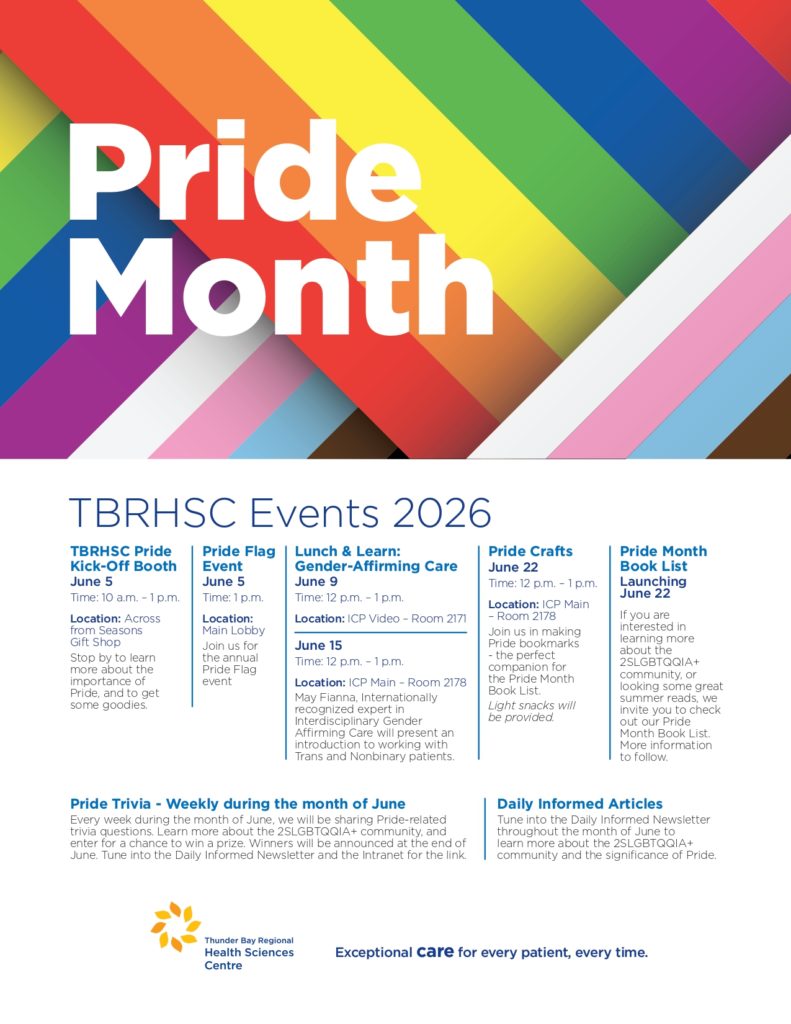
As Pride Month encourages us to address discrimination towards the 2SLGBTQQIA+ community, the 2SLGBTQQIA+ Subcommittee and Pride Working Group, on behalf of the Equity, Diversity, and Inclusion Steering Committee invite you to celebrate Pride, and work towards a more inclusive future for 2SLGBTQQIA+ patients, families, staff, and community members. To see what events are taking place throughout the month, check out the poster below: